A reliable subcontractor for maintenance at height can be recognized by three things: demonstrable certification, a transparent safety record, and the technical breadth to carry out the full scope independently. For clients in heavy industry, offshore, or wind energy, this distinction is crucial, because the consequences of the wrong choice reach further than a failed project. The questions below will help you at every step of the selection process.
Which certifications should a subcontractor for work at height have?
A serious subcontractor for work at height holds at least a VCA-P certification, a recognized trade qualification for the access system being used, and preferably an ISO 9001 quality management certification. For industrial maintenance at height using rope access techniques, IRATA company certification is the most decisive quality mark you can require.
The crucial distinction with IRATA is that many companies work with IRATA-certified technicians but are not certified as a company themselves. An IRATA-certified company falls under the supervision of the international IRATA organization, is required to record all hours worked and incidents, and undergoes a full external audit every three years. A non-certified company has none of these obligations. That makes a substantial difference for clients who need demonstrable safety and quality assurance in tenders and permit processes.
For work in the petrochemical industry, VCA-P, the petrochemical variant of the VCA checklist, is the highest company certification attainable and in many cases a contractual requirement. If you combine this with IRATA company certification and ISO 9001, you have a subcontractor that demonstrably scores on all three quality dimensions: safety, technical competence, and process control.
What is the difference between a scaffolder and a rope access specialist?
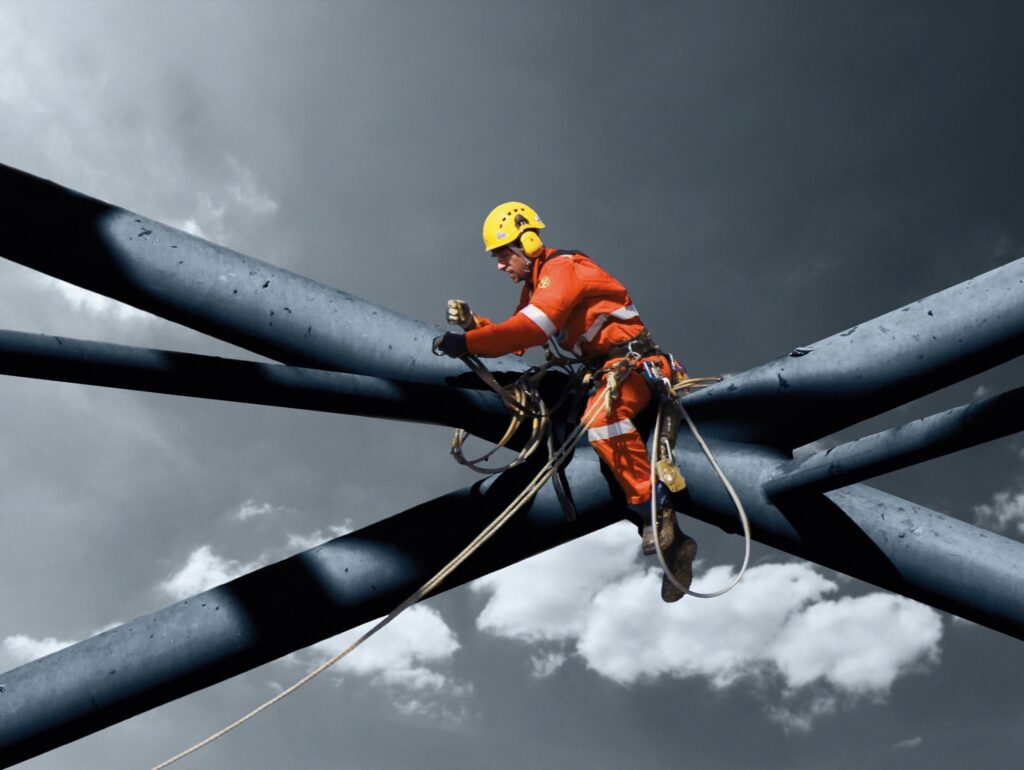
A scaffolder supplies only the platform on which others carry out the work. A rope access specialist is the skilled tradesperson who brings their own means of access and carries out the technical work on site themselves. The right comparison is therefore not rope access versus scaffolding, but: scaffolder plus technical contractor combined versus a rope access specialist.
This distinction has direct consequences for project costs, lead time, and coordination effort. Traditional scaffolding involves at least two parties: the scaffolder who provides access and the technical contractor who carries out the actual work. That means two contracts, two schedules, two points of contact, and a considerable amount of equipment on site. Scaffolding also blocks driving routes, loading and unloading positions, and access roads on an industrial site, causing logistical disruption that feeds through into the total project costs.
A rope access subcontractor integrates access and execution in a single team. Less equipment is needed, mobilization time is shorter, and the footprint on site is minimal. Every day of reduced downtime means a direct cost saving for the client.
How do you assess a subcontractor's safety record?
Ask about the subcontractor's incident registration system, the Lost Time Injury Frequency (LTIF), and whether the company is required to report incidents to an external supervisory body. For an IRATA-certified company, this reporting obligation is contractually embedded in the membership, which enforces a transparency that is lacking among non-certified providers.
A concrete safety indicator is the presence of an IRATA level 3 supervisor on every job. This supervisor is responsible for the rope safety of the operation and for setting up the rope system. For a serious rope access subcontractor, this is not an option but an obligation. Ask about this explicitly and have it confirmed in the contractual terms.
Statistically, rope access has the lowest incident rate of all methods for working at height. That sounds counterintuitive, but there is a logical explanation: rope access technicians are secured at all times via multiple anchor points and cannot simply unclip themselves for convenience while moving. On scaffolding, technicians regularly do exactly that, resulting in fall incidents. For HSE managers, this is a relevant consideration when assessing providers.
What questions should you ask when selecting a technical subcontractor?
When selecting a subcontractor for industrial maintenance at height, seven questions are indispensable: Is the company itself IRATA-certified as an organization? Does it hold VCA-P? Is a level 3 supervisor present on every deployment? Does the company work with its own, periodically inspected equipment? Can it carry out the full technical scope independently? What is the average lead time for comparable projects? And how does the company safeguard the quality of work that the client cannot check themselves?
That last question is more often underestimated than you might think. Work at height is seldom directly visible or verifiable for the client. A reliable subcontractor has a demonstrable quality assurance system: daily humidity measurements, coating thickness measurements with documentation, and pull-off tests on new coating are examples of working methods that make quality verifiable.
Also pay attention to how a provider positions its hourly rate. A slightly higher hourly rate at a certified company is generally justified by the stricter requirements it meets. The total solution, including a shorter lead time and the elimination of costs for a separate contractor, is in most cases cheaper than the alternative.
When is rope access cheaper than traditional scaffolding?
Rope access is cheaper than traditional scaffolding when the combination of scaffolder plus technical contractor is included in the comparison, when the location is difficult to reach, when lead time determines the total project costs, or when the logistical effect of scaffolding on site causes additional costs.
In the petrochemical industry, where plants carry out a turnaround every two to four years, the potential savings are greatest. During a turnaround, the plant is completely shut down. Every extra day of downtime has direct financial consequences. Rope access mobilizes faster, needs less equipment, and can start the technical work sooner. In documented cases, this has delivered savings of millions of euros for a single client during a turnaround.
In infrastructure projects, such as maintenance on bridges and viaducts, a different cost aspect comes into play: traditional suspended scaffolding requires lane closures, which causes traffic disruption and associated costs. Sky-Access's modular SkyDeck platform can be suspended beneath a structure without blocking lanes, which offers both logistical and financial advantages.
In offshore wind energy, the savings on major blade repairs can be made concrete: deploying a crane vessel for tip replacements or major repairs at sea costs considerably more than a specialized blade platform. The difference can run to more than 100,000 euros per deployment.
How do you verify that a subcontractor truly works multidisciplinary?
A truly multidisciplinary subcontractor can demonstrably carry out the full technical scope independently: from welding and NDT inspections to blasting, painting, insulation, and assembly, without having to bring in a separate party for each discipline. Ask for reference projects in which multiple disciplines were carried out simultaneously by a single team.
The practical proof lies in the project organization. A truly multidisciplinary provider has technicians who are certified in multiple technical disciplines and can put together a single team that combines coating, insulation, NDT, and welding. This delivers a logistical advantage: less coordination, fewer changeovers on site, a shorter lead time, and a single point of contact for the client.
Also pay attention to how a company positions itself. A provider that describes itself primarily as an access provider is fundamentally different from a technical execution partner that brings its own means of access. Sky-Access is an example of a company that integrates both roles in one team, with disciplines such as welding, NDT, tank maintenance, blasting and painting, and assembly as standard parts of its own scope.
If in doubt, ask about the specific certification of the technicians per discipline, the internal quality procedures per field, and the way in which the company documents the quality of the work delivered. A reliable subcontractor has a concrete and verifiable answer to all these questions.
Related Articles
- How to Minimize Downtime in Industrial Maintenance?
- How Long Does Maintenance on an Industrial Tank Take on Average?
- What Is the Difference Between an NDT Inspection and a Visual Inspection?
- How do you know if a maintenance company has the right certifications?
- Sky-Access at great heights: innovative access solutions for the Euromast in Rotterdam

 NL
 EN