Targeted technical work on the Euromast suits rope access if the technician can carry out the task from a suspended working position. If the work requires a fixed posture for a long time, a stable floor, or room for heavier tools, a suspended platform or scaffolding comes into play. The choice applies per work section: load, environmental conditions, and the organization of access and execution all help determine what works.
The shaft and the technical work determine the scope
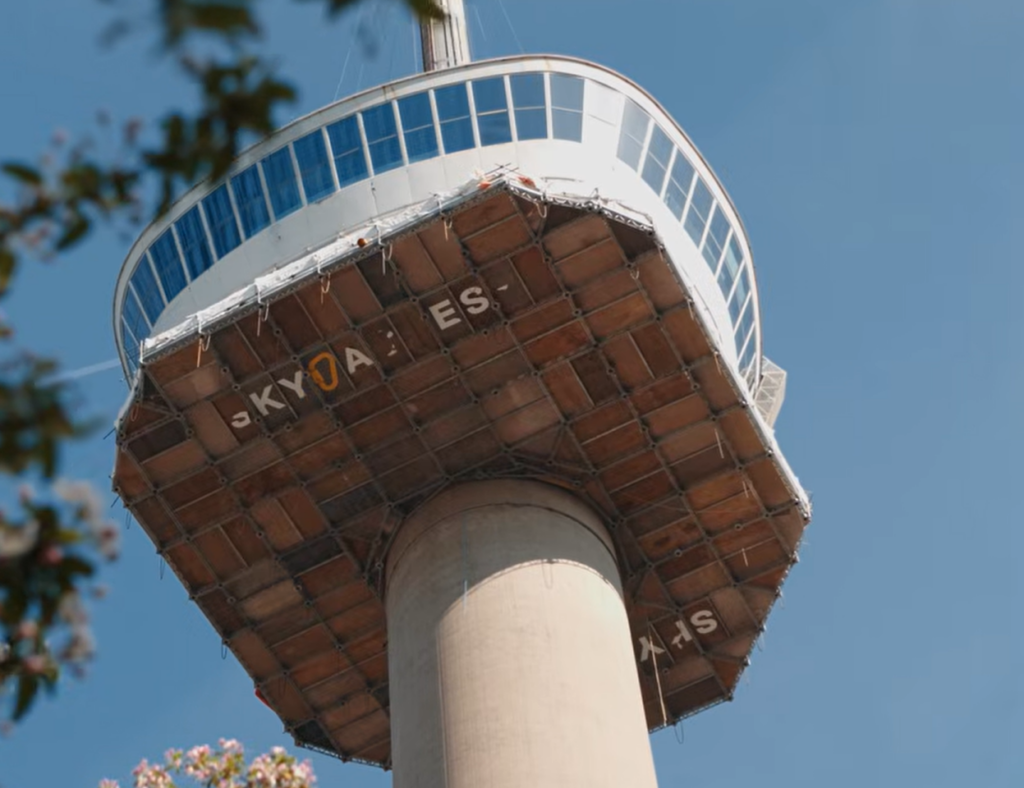
According to the Architectuurgids, the concrete shaft of the Euromast is 107 meters high and 9 meters in diameter. For work at height on the Euromast, that makes the size of a work section more important than height alone: a local inspection places different demands on access than conservation over a larger surface or installation with a lot of material.
The project videos about the Euromast Project 2026 mention our involvement. Non-destructive testing (NDT), conservation, welding, and installation or dismantling are disciplines we carry out with rope techniques on other projects. These are therefore possible tasks to assess at the shaft, not a confirmed work list for the Euromast.
Working posture and load drive the choice of work position
According to Arboportaal, a safe, ergonomically sound working floor is the starting point for work at height. If that is not possible, the most suitable work equipment must be chosen. For choosing between access solutions at height, what the technician actually has to do on site therefore counts.
| Access | Working posture and working floor | Load and suitable work |
|---|---|---|
| Rope access | The technician reaches the work position on ropes and carries out the technical task there: access and technical execution in one. Working for a long time in the same posture with both hands free is harder, according to the explanation of the limitations of rope access. | Suits targeted work in hard-to-reach places. Mechanically heavy tools call for a supplementary or combined solution. |
| Suspended platform | A modular platform provides a stable working surface when posture or precision requires it. At the Haringvliet sluices, for example, we used it for 3D scans of support arms. That is not confirmation of platform use at the Euromast. | We specify a load capacity of up to 360 kg/m². The platform can cantilever 2.5 meters; on that section, 240 kg/m² applies. Check these values against the intended setup, not just against the weight of a single technician. |
| Scaffolding | Offers a fixed working floor for long-duration work over a larger contiguous surface, but after construction, skilled technical tradespeople still have to carry out the work. | Also comes into play when execution requires a different working floor or access for materials. At the Broeklandcollege, we built scaffolding on a one-off basis to place anchors in roof trusses. |
Compare setup moments and technical deployment per work section
Don't compare cost and lead time as "ropes versus scaffolding", but as two execution plans. In one plan, a scaffolder builds the access and a technical contractor carries out the work. In the other, a team using rope access reaches the location and also carries out the technical task there. That difference becomes most noticeable when inspection, assessment, and repair follow one another per work section: a multidisciplinary team can combine those steps in a single visit.
So set side by side, per work section, the mobilization, any platform or scaffolding setup, material handling, technical hours, and removal of the access. Factor in coordination between parties as well. A scaffold that remains usable for a long time for work over a large surface may turn out more favorable than repeatedly deploying rope-access teams anew; for scattered, targeted tasks, the setup moments weigh more heavily. On a factory site, it also matters whether a scaffold obstructs driving routes or loading positions.
The case of a turnaround at an industrial site in the Botlek shows why that comparison is needed per location: for the places where we applied rope techniques in late 2023, that case reports a cost saving of 60 percent. That is an outcome of that deployment, not a percentage to apply to the Euromast or to the lead time of another project. With a combined scope, it must also be established that the technicians hold the required trade certification per discipline in addition to their rope-access qualification.
Fall hazard, preparation, and rescue set the limits of rope-access work
The fastest access does not automatically produce a workable work plan. For rope-access work on the shaft, this check belongs on the table before the method is chosen:
- Avoid work at height where possible. According to Arboportaal, the employer must first assess whether the work can be done without working at height and whether the fall hazard can be avoided. From 2.50 meters, measures against fall hazard are required, but also below that if there is a risk of falling.
- Record the conditions and the stop limit. Assess, among other things, weather and the risk of falling objects. Rope access is not suitable when the weather makes suspended work unsafe; the work plan must state when work stops and who makes that decision.
- Check people, equipment, and permits. The explanation names risk analysis, work permit, and equipment inspection as preparation. In composing the team, both rope-access experience and professional competence for the task count. Every deployment under the international rope-access standard includes a level-3 supervisor for rope-access safety and the setup of the rope system; that person does not automatically lead the technical work.
- Make rescue feasible from the work position. The rescue plan must describe how an injured or unconscious technician is extracted from that position. A plan that only describes how someone gets down is insufficient for this.
For a deployment under the international rope-access standard, choose a certified company and also check the personal certification of the technicians. The explanation of the requirements for rope-access technicians mentions our company certificate with number 5025/0; that company certificate is something different from the qualification of the people who work on the ropes.
The technical task determines access per work section
A usable request for quotation records, per work section, the technical task, required space and load-bearing capacity, tools, permitted conditions, and rescue route. Only then can the combined deployment of access and technical execution be fairly compared with a scaffolder plus a technical contractor, including their mobilization and setup moments.
Related Articles
- How to Minimize Downtime in Industrial Maintenance?
- How Is Maintenance Carried Out on Hard-to-Reach Industrial Installations?
- What Is the Difference Between Maintenance With and Without Scaffolding?
- Why does erecting scaffolding take so much time in industrial maintenance?
- How do you know if a maintenance company has the right certifications?

 NL
 EN