The main difference between maintenance with and without scaffolding is that scaffolding separates access from execution: a scaffolder supplies the platform, while a separate technical contractor carries out the work. Rope access combines both in a single team, which shortens lead times, reduces the logistical burden on site and, in most cases, significantly lowers total project costs.
This distinction is particularly relevant for clients in heavy industry, petrochemicals and the offshore sector, where downtime directly costs revenue and logistical space on site is scarce. The following questions explore the key differences between the two methods in practical terms.
What are the main cost components of scaffolding?
With scaffolding, costs consist of two separate items: the scaffolder who supplies the platform and the technical contractor who carries out the work. On top of that come the costs of equipment, transport, erection and dismantling time, and the logistical consequences of a scaffold standing on a site for weeks or months. The total project cost is therefore structurally higher than many clients estimate in advance.
A scaffold is essentially a temporary workplace with no execution value of its own. The structure has to be designed, approved, erected, maintained and dismantled again. Each of these steps costs time and money before the technical work has even begun. In a petrochemical turnaround, where the plant is shut down completely for major maintenance, large quantities of scaffolding are traditionally erected. The cost of that scaffolding mounts quickly, while every day of downtime means a direct loss of revenue.
In addition, scaffolds block traffic routes, loading and unloading positions and access roads on an industrial site. This logistical disruption carries indirect costs that rarely appear in a quotation but weigh heavily in practice. Crane paths are blocked, supply routes for other contractors are restricted and overall operational flexibility on site decreases for as long as the scaffold stands.
How does rope access work as an alternative to scaffolding for maintenance?
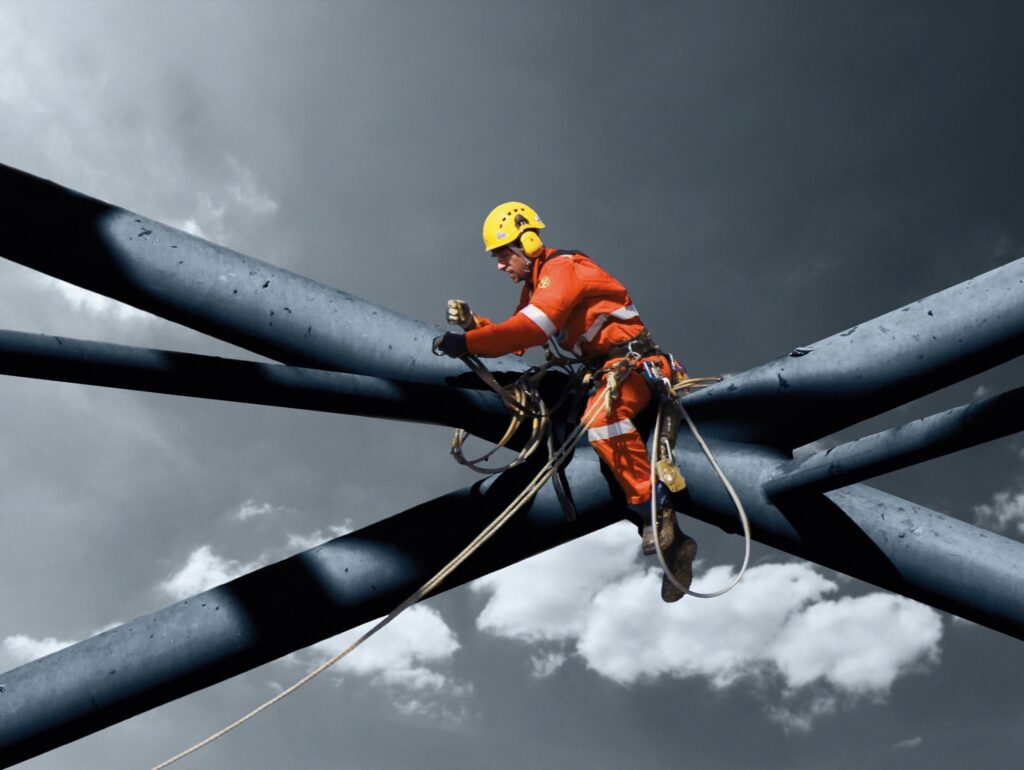
With rope access, certified specialists reach the work location via rope systems while carrying out the technical work at the same time. No separate platform needs to be erected beforehand. The access method and the skilled worker are combined in one person and one team, which shortens lead time and reduces the coordination burden for the client.
The comparison that clients often make is not quite right. Rope access is not the counterpart of a scaffolder, but of the combination of a scaffolder and a technical contractor. A company like Sky-Access is not an access provider that then waits for another party to carry out the work. It is a technical specialist that brings its own means of access and carries out the full scope itself, from access to handover. An overview of how this is organized in practice can be found on the page about rope access services.
In practice it works as follows: the rope access specialists set up a rope system from a roof, a structure or an existing anchor point. They then descend to the work position, carry out the technical work and leave the site without a permanent structure remaining on the premises. The footprint is minimal, mobilization time is short and the site remains operationally accessible.
Which maintenance tasks are suitable for rope access?
Rope access is suitable for a wide range of technical maintenance work at height and in confined spaces, including welding, NDT inspections, blasting and painting, insulation work, corrosion under insulation (CUI), tank maintenance, assembly and disassembly, and fireproof coatings. The method is not limited to light or simple tasks; multidisciplinary teams also carry out complex, precise and heavy work.
A common misconception is that rope access is only suitable for inspection or simple maintenance. In practice, specialized companies use rope systems to carry out full welding scopes, apply protective coating systems in accordance with ISO 12944, replace insulation on pipes and boilers, and perform non-destructive testing on hard-to-reach structures. Technical expertise is central; rope access technique is the means of getting to those locations.
For large continuous surfaces where work at height is permanent, such as shell construction projects on apartment buildings, scaffolding is more efficient. But for the vast majority of industrial maintenance at height, including offshore structures, bridges, tanks and petrochemical installations, rope access is a fully fledged and often more cost-efficient alternative. For lifting weights that structurally exceed 300,000 kg, other methods are appropriate.
What are the safety differences between scaffolding and rope access?
Statistically, rope access has a lower incident rate than scaffolding work. The biggest risk with scaffolding is not the structure itself but the behavior of the workers on it: to move freely, they regularly unclip from their fall protection, which leads to fall incidents. Rope access specialists are attached at all times via a two-point system and cannot release that system without a deliberate action.
With rope access, an IRATA Level 3 supervisor must be present on every job. This supervisor is responsible for rope safety, setting up the rope system and supervising the execution. IRATA, the Industrial Rope Access Trade Association, sets strict requirements for certified companies: all hours and incidents are recorded and reported to the international organization, and a full audit takes place every three years.
An important distinction that clients must make in tenders: many companies work with IRATA-certified technicians but are not themselves certified as a company. A non-certified company is not supervised by the international IRATA organization and is not obliged to report incidents. A serious client always chooses an IRATA-certified company. Sky-Access is IRATA-certified as a company under certificate number 5025/0 and also holds VCA-P certification, the highest attainable company certification in the petrochemical industry, as well as ISO 9001. More about the background and certifications can be found on the page about Sky-Access.
When is rope access faster than traditional scaffolding?
Rope access is faster than scaffolding when the erection time of the scaffold forms a significant fraction of the total project duration, when the work is spread over several locations on a structure, or when a quick response is needed to a finding during an inspection. In those cases, a rope access team can start the technical work the same day.
In the petrochemical industry, this difference is most visible during turnarounds. Traditionally, large quantities of scaffolding are erected in the weeks before a shutdown, which requires additional personnel, equipment and logistical coordination. A rope access team mobilizes quickly, starts the technical work immediately and leaves the site without dismantling work that would delay the restart of the installation.
In wind energy too, speed is a decisive factor. Every day a turbine stands idle costs the owner direct revenue. For offshore wind turbines, Sky-Access can combine inspections and repairs in the same deployment, without having to hire a crane vessel. For large-scale offshore repairs to turbine blades, the patented blade platform was developed, which delivers savings of more than €100,000 per deployment compared with a crane vessel. More about the approach for the offshore sector can be found on the page about offshore services.
When does scaffolding remain the better choice?
Scaffolding is the better choice when work is carried out continuously and intensively on large continuous surfaces over a longer period, when lifting weights structurally exceed 300,000 kg, or when the nature of the work requires a permanent, stable work floor for several disciplines simultaneously over a longer period.
A good example is large-scale new construction or shell construction where dozens of people work permanently at height on a continuous facade or structure. In that situation, a scaffold is more efficient because the fixed investment in erection is recovered through intensive, long-term use. In that scenario, rope access is less cost-effective, not because the method falls short, but because the ratio between erection time and working time is different.
For situations where scaffolding is logistically unfeasible but a stable work floor is still needed, there is an intermediate solution. The modular SkyDeck suspended platform from Sky-Access combines the advantages of a fixed work floor with the low footprint of rope access. The platform is suspended beneath structures such as bridges, locks or offshore helidecks without lanes having to be closed, and it can be erected so quickly that it is also cost-effective for shorter projects. That makes it an alternative for situations where a traditional suspended scaffold would normally be the only option.
Related Articles
- When is technical maintenance without scaffolding the better choice?
- Why is a multidisciplinary team more efficient for maintenance at height?
- How Is Technical Maintenance Carried Out on Industrial Installations?
- How does a blade repair on an offshore wind turbine work?
- Sky-Access at great heights: innovative access solutions for the Euromast in Rotterdam

 NL
 EN