A multidisciplinary team is more efficient for maintenance at height because access and execution are in one hand. Instead of a scaffolder supplying a platform and a separate technical contractor carrying out the work, one team performs the entire scope, from welding and NDT inspections to blasting and painting. That eliminates coordination losses, shortens lead times and significantly lowers total costs. The following questions explore each aspect of this approach in more detail.
What are the concrete benefits of one team for the entire scope?
When one team carries out the entire technical scope, the coordination and waiting times that arise from switching between a scaffolder and a technical contractor disappear. The team starts work immediately once the location is accessible, works to a single schedule and reports through a single point of contact. This results in shorter lead times, less logistical overhead and stronger quality assurance.
In practice, this means that specialists such as welders, coating inspectors, NDT technicians and insulation fitters are deployed together on the same job. Because they operate as an integrated team, work can be carried out in parallel rather than sequentially. An NDT inspector can pass a finding directly to the welder working beside them, after which the coating specialist finishes the repair, without the installation having to be made accessible again.
For clients in heavy industry and the offshore sector, this also means less supplier management. There is no need for a separate contractor for the technical work and no separate party for access. Sky-Access works as a technical execution partner that brings its own access equipment: the technician with the scaffold in his back pocket, as it is described internally. That makes the procurement structure simpler and the division of responsibilities clear.
How does a multidisciplinary team reduce installation downtime?
A multidisciplinary team reduces installation downtime because inspection and repair can be combined during the same deployment. No second mobilization is needed if an inspector finds a defect: the repair technician is already on site. Every day less downtime is a direct gain, because every day an industrial installation is not producing costs the owner revenue.
In the petrochemical industry, installations are shut down every two to four years for a turnaround: a period of six to eight weeks of major maintenance. Traditionally, enormous amounts of scaffolding are built during this period, which in itself costs time and space before the first technical work can begin. A multidisciplinary rope access team can mobilize considerably faster, start execution earlier and carry out multiple tasks simultaneously at locations that are difficult or slow to reach with conventional methods.
The same principle applies to tank maintenance. Sky-Access's own system for spherical tanks makes full access to the tank possible within half a day. What takes five weeks with conventional scaffolding can be reduced to one week, with fewer people on site and a lower risk profile. That time saving translates directly into shorter installation downtime.
Why is rope access particularly well suited to multidisciplinary work?
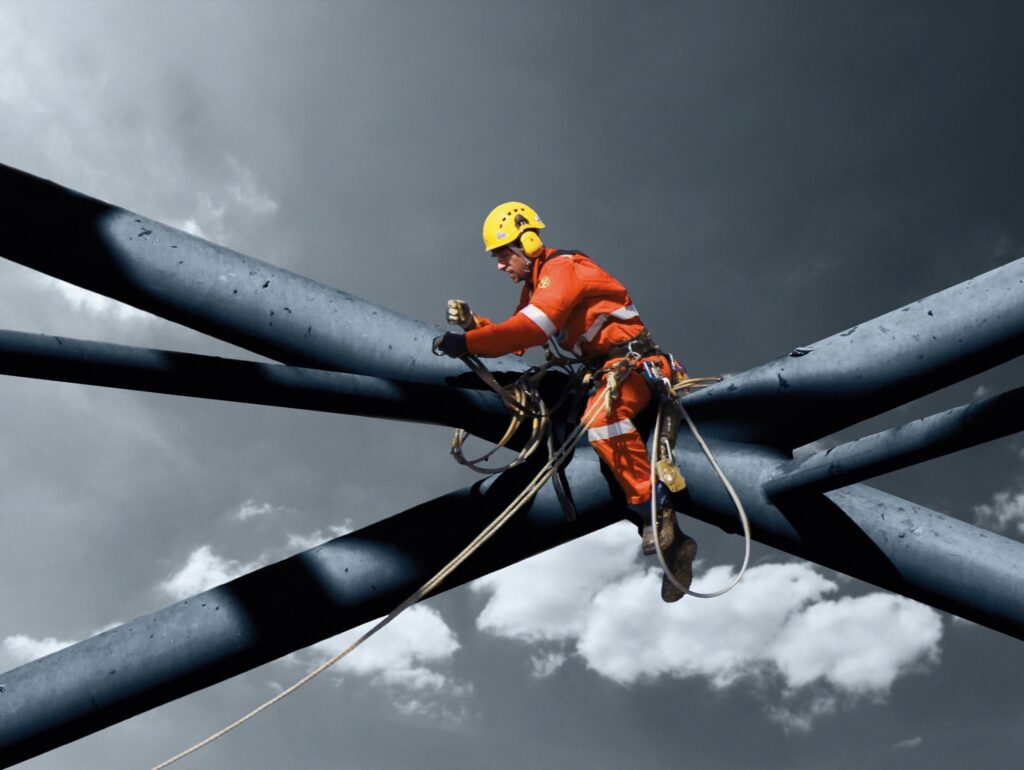
Rope access is particularly well suited to multidisciplinary work because the technique itself requires no fixed infrastructure that gets in the way of other disciplines. There is no scaffolding that has to be erected before work can begin, no aerial work platforms blocking access routes and no platforms occupying loading and unloading positions. The rope access technician brings their own workplace and can thereby reach virtually any location at height or in a confined space.
This makes it possible to deploy multiple disciplines on the same structure at the same time without them getting in each other's way. Where a scaffolder installs a platform that is then used by one discipline at a time, rope access specialists with different trade backgrounds can work simultaneously at different points on the same installation. That is a structural advantage in complex maintenance assignments where coating, insulation, welding and inspection are all part of the scope.
Sky-Access's approach illustrates this principle directly: the company trains technicians with a strong technical trade background: a welder who learns to climb, not a climber who learns to weld. The technical quality of the work carried out is central; rope access technique is the means of reaching hard-to-access locations. This ensures that the multidisciplinary team is not only able to reach heights, but also delivers genuinely skilled work.
For structures where rope access alone would be less efficient for prolonged, heavy work, the SkyDeck platform offers a complement: a modular, lightweight yet heavy-duty suspended platform that can be quickly assembled and dismantled and can also be used by multiple disciplines at the same time.
What is the difference between a multidisciplinary rope access team and a traditional approach?
The key difference is that in a traditional approach, access and execution are two separate contracts: a scaffolder supplies the platform, a technical contractor carries out the work. With a multidisciplinary rope access team, both are in one hand. That eliminates the handover costs, the waiting times and the coordination burden that arise when two parties depend on each other's schedules.
The traditional approach: two parties, two schedules
With conventional work at height, a client hires a scaffolder who builds the platform. Only when that is finished can the technical contractor begin. If the scaffold is not in the right place, or if the scope changes, the scaffolder has to return. Every coordination step between these two parties costs time and increases the risk of schedule disruption. Moreover, scaffolds take up logistical space on site: access routes, loading and unloading positions and approach roads get blocked, which hinders the client's operational processes.
The multidisciplinary rope access model: one party, full scope
With a multidisciplinary rope access team, there is no separate access provider. The technicians reach the workplace via rope access and carry out the technical work there directly. Welding, NDT inspections, blasting and painting, insulation and assembly can all be performed by the same team, aligned to a single schedule. There is less equipment on site, less transport and less space used. The footprint on site remains minimal, leaving the client's logistical processes undisturbed.
From a safety perspective, there is another relevant distinction. Statistically, rope access has the lowest incident rate of all methods for working at height. With scaffolding work, workers regularly unclip because constantly clipping and unclipping is cumbersome in practice, which increases the risk of falls. Rope access technicians from an IRATA-certified company are secured at all times via multiple anchor points, and every job requires an IRATA Level 3 supervisor to be present who is responsible for rope safety.
When is a multidisciplinary team the right choice for a project?
A multidisciplinary rope access team is the right choice when a project combines multiple technical disciplines at hard-to-reach locations, when downtime must be minimal and when a conventional scaffolder plus technical contractor would be logistically or financially too burdensome. The more disciplines needed at the same location, the greater the advantage of one integrated team.
Concrete situations in which this approach structurally outperforms the traditional method include turnarounds in the petrochemical industry, maintenance on offshore platforms in the North Sea, tank maintenance where rapid access is essential, and infrastructure projects where scaffolding would block carriageways or logistical routes. In all of these cases, the combination of fast mobilization, minimal footprint and breadth of technical expertise is decisive.
There are also situations where rope access is less obvious. For prolonged work on large continuous surfaces (such as structural shell construction where work at height is permanent), scaffolding is more efficient. The choice of a multidisciplinary rope access team is therefore not a dogma, but a trade-off based on the project scope, the accessibility of the location and the desired lead time.
For clients who want to assess whether this approach suits their specific situation, Sky-Access offers more than fifteen years of experience as an IRATA-certified company, with VCA-P certification and ISO 9001 as additional quality assurance. That combination of certifications is relevant in tenders and permitting processes where the safety record and demonstrable quality standard of the executing party are assessed.
Related Articles
- When is technical maintenance without scaffolding the better choice?
- What Are the Benefits of Technical Maintenance Without Scaffolding?
- What Is Technical Maintenance at Height in Industry?
- What Are the Most Common Damage Patterns in Wind Turbine Blades?
- What Is the Difference Between an NDT Inspection and a Visual Inspection?

 NL
 EN