Technical maintenance without scaffolding is, in most cases, faster, cheaper, and safer than traditional scaffolding combined with a separate technical contractor. Using industrial rope techniques, known as rope access, specialized professionals reach hard-to-access locations without the need for a separate scaffolding company. The following questions explain the main advantages, applications, and quality requirements.
How does technical maintenance without scaffolding work in practice?
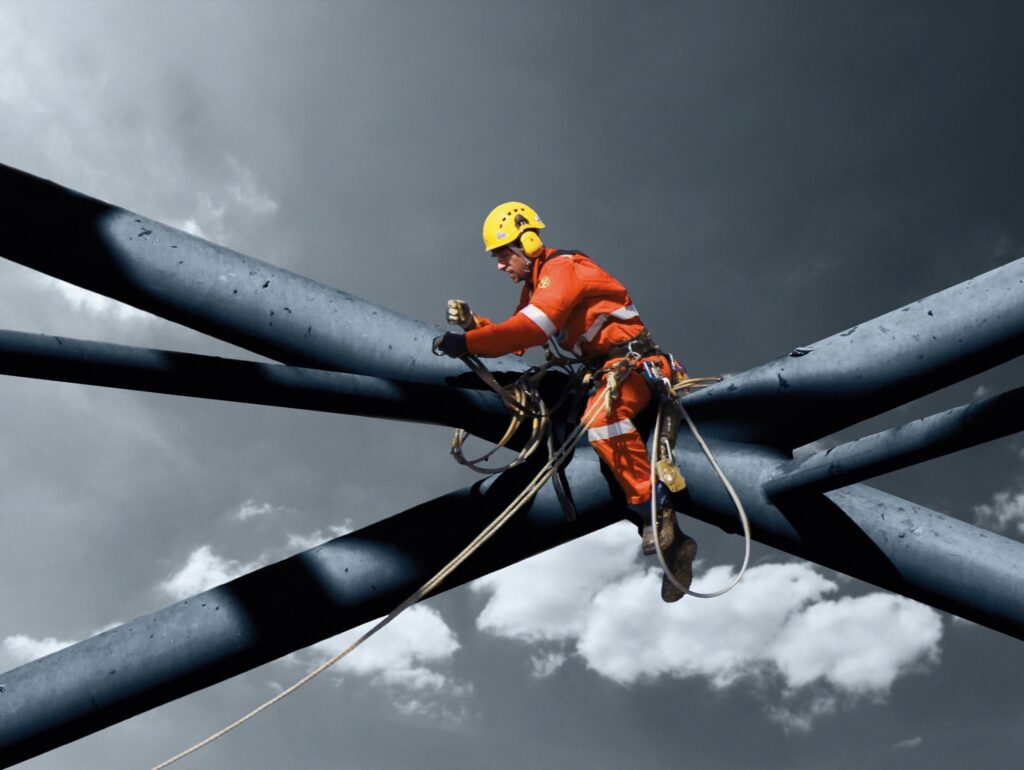
With technical maintenance without scaffolding, certified professionals use rope access techniques to reach workplaces at height or in confined spaces. The technician descends or ascends via a system of ropes and anchor points and carries out the technical work on the spot. Access and execution are thus handled by a single party.
The crucial difference from conventional working is the comparison you need to make: not rope access versus a scaffold, but rope access versus a scaffolder plus a separate technical contractor. With traditional work, a scaffolder only supplies the platform; a welder, painter, or NDT inspector then carries out the work. Sky-Access combines both roles: the specialist brings their own means of access.
In practice, this means a multidisciplinary team, with specialists for welding, conservation, NDT inspections, or insulation, arrives on the same day, reaches the workplace, and starts the technical work immediately. There is no waiting time for scaffold erection, no separate coordination between two contractors, and no logistical alignment on equipment handover. One team, one point of contact, one integrated scope from access to completion.
Technical quality is central here. Sky-Access works on the principle: teach a welder to climb, not a climber to weld. Technical craftsmanship is the foundation; rope access is the means to reach difficult-to-access locations.
What are the cost advantages compared to traditional scaffolding?
The cost advantages of rope access maintenance compared to traditional scaffolding stem from three interrelated factors: shorter lead time, less equipment on site, and the elimination of a separate technical contractor. The exact savings vary per project, but the structural mechanisms are consistent.
During an industrial turnaround, the periodic maintenance shutdown in the petrochemical industry that typically lasts six to eight weeks, large quantities of scaffolding material are traditionally erected. That takes time before the technical work can begin, and time after completion for dismantling. Every day a plant is idle, the client loses revenue directly. Rope access largely eliminates those preparation and follow-up phases: the team mobilizes quickly and can usually start the technical work on the same day.
In addition, there is no need to contract and coordinate two parties. Combining a scaffolder and a technical contractor entails double mobilization costs, double overhead structures, and coordination risk. With rope access maintenance, there is a single contracting party managing the entire scope.
A concrete example of the cost savings can be seen in offshore wind maintenance: Sky-Access's patented blade platform makes major repairs to wind turbine blades at sea possible without a crane vessel, saving more than 100,000 euros per deployment compared to that conventional method. A similar pattern applies to spherical tanks: what takes five weeks with traditional scaffolding is achieved in one week with the company's own application system, with fewer people on site.
Is working with rope access techniques safer than with scaffolding?
Rope access is statistically the safest method for working at height. Industrial rope techniques have a lower incident rate than scaffolding work, which is explained by the way both methods handle personal fall protection.
On scaffolds, fitters regularly unclip themselves because constantly clipping and unclipping while moving is impractical. This leads to fall incidents that are structurally prevented with rope access: rope access technicians are secured at all times by a two-point system. Letting go is not an option; the system is designed so that the technician is always attached to at least two independent lines.
Scaffolds are not an unsafe method in themselves, but the statistics show that fatal fall incidents occur more often with scaffolding work than with rope access. The paradox is that the apparent solidity of a scaffold floor gives fitters a sense of safety that leads them to disconnect their personal protection.
On every job by Sky-Access, an IRATA level 3 supervisor is required to be present. This supervisor is responsible for rope-technical safety and for setting up the rope system. In addition, the team acts as a rescue team for work in confined spaces: the specialists are trained in rescue techniques and can quickly and safely evacuate their own staff or third parties in the event of an incident.
Where can rope access be deployed where scaffolds cannot go?
Rope access for industrial maintenance can be deployed at any location where a scaffold is logistically unfeasible, structurally impossible, or too costly. That includes offshore structures, the undersides of bridges and viaducts, spherical and cylindrical tanks, architecturally complex facades in urban environments, and offshore wind turbines.
Industrial installations and tanks
In the petrochemical industry, spherical tanks and columns offer little room for conventional scaffolding. Sky-Access uses a patented Mono Arm to safely reach the walls of spherical tanks, cylindrical tanks, and silos. In cylindrical tanks, truss structures are used for safe and efficient access where conventional anchor points are lacking. Never write that geometry or anchor points pose an obstacle: the technique was developed precisely to solve this.
Bridges, locks, and infrastructure
Under bridges and locks, Sky-Access works using its own modular SkyDeck suspended platform. This platform is attached to the main structure via tensioning chains and is wider than the structure itself, so the sides can also be reached. Traditional suspended scaffolds require road closures; SkyDeck works entirely beneath the structure without affecting traffic above. There is currently a considerable maintenance backlog on infrastructure in the Netherlands and Flanders, a market where rope access offers a direct logistical advantage.
Offshore and urban environments
On offshore platforms, ships, and wind turbines at sea, the footprint of rope access is a decisive advantage: less transport, less equipment, quick mobilization. In urban environments, for facades, parking garages, or architecturally complex buildings, rope access is sometimes the only method when the ground cannot bear the weight of an aerial work platform or when there is no space for scaffolding.
When is maintenance without scaffolding the better choice?
Maintenance without scaffolding is the better choice when the location is difficult to access, the lead time must be kept short, or when logistical disruption on a busy industrial site is unacceptable. Rope access is particularly suited to inspection, maintenance, cleaning, coating, lightning protection, and emergency repairs at height or in confined spaces.
A specific situation where rope access is structurally preferable is the industrial turnaround. During a maintenance shutdown, every day counts. Scaffolds also block driving routes, loading and unloading positions, and access roads on a plant site; rope access does not have that drawback. The team works compactly, mobilizes quickly, and keeps operational processes around the workplace disrupted as little as possible.
There are situations where scaffolds are more efficient. For prolonged work on large contiguous surfaces, such as the shell construction of an apartment building where work at height is continuous, scaffolds are the logical choice. The same applies to lifting weights that structurally exceed 300,000 kg. Rope access is not a universal answer, but for most maintenance tasks in industry, offshore, and infrastructure, it is the faster, cheaper, and safer route.
For offshore oil and gas installations, additional considerations apply: for safety reasons, rope access work is carried out exclusively in daylight, and offshore working days always last 12 hours. Quick mobilization and a minimal footprint are not a luxury in that environment but an operational necessity.
What certifications should a rope access company have?
A serious rope access company has, at a minimum, IRATA company certification, VCA-P certification, and ISO 9001. The distinction between a company that has IRATA-certified technicians and a company that is itself IRATA-certified as an organization is crucial, and is underestimated by many clients.
Many rope access companies work with technicians who are personally IRATA-certified at level 1, 2, or 3, but the company itself is not certified. A non-certified company is not supervised by the international IRATA organization, is not required to report incidents, and is not periodically audited. This has direct consequences for safety assurance and the reliability of the quality system.
Sky-Access is IRATA-certified as a company (company certificate number 5025/0) and has been for more than 15 years. This means that climbing equipment and procedures are documented in a system that external auditors thoroughly review every three years, comparable to the VCA-P audit. All technicians hold a personal IRATA certificate, and on every job a level 3 supervisor is required to be present, responsible for rope-technical safety.
VCA-P certification, the highest attainable company certification in the industry, specifically for petrochemicals, is required for work in refineries and chemical plants. Only a few rope access companies in the Netherlands can present the combination of IRATA company certification, VCA-P, and ISO 9001. For clients who need demonstrable safety guarantees in tenders and permit processes, this distinction is decisive. More about the working method and certification philosophy of Sky-Access can be found on the about us page.
Related Articles
- What Is the Difference Between Maintenance With and Without Scaffolding?
- What Is Technical Maintenance at Height in Industry?
- How to Choose a Reliable Subcontractor for Maintenance at Height
- How Are Wind Turbine Blades Inspected for Damage?
- How do you know if a maintenance company has the right certifications?

 NL
 EN