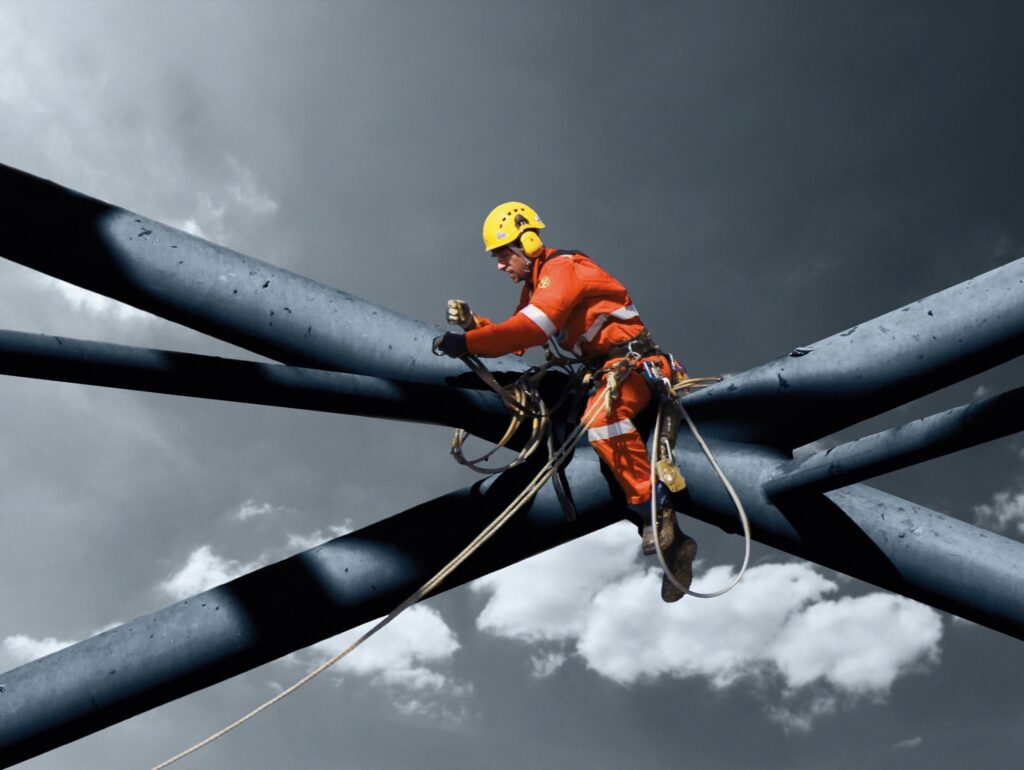
Technical maintenance at height in industry covers all technical work on installations, structures, or equipment located at a height that cannot be safely reached without special access equipment. Think of welding work on reactor vessels, NDT inspections of piping at height, blasting and painting work on industrial structures, or the assembly and disassembly of equipment in hard-to-reach locations. This type of maintenance places specific demands on both technical expertise and the access method. In this article, we answer the most frequently asked questions about working at height in industry.
Which activities fall under technical maintenance at height?
Technical maintenance at height covers all specialist work carried out at locations that cannot be reached via a floor or platform at ground level. In industry, this involves a wide range of disciplines: welding work, NDT inspections, assembly and disassembly of equipment, blasting and painting work, insulation work, and construction work on installations, tanks, columns, pipe racks, and other elevated structures.
It is important to distinguish between access and execution. A scaffolder supplies only the platform. The technical work is then carried out by a separate contractor. With industrial maintenance at height via rope access, access and execution are integrated into a single party. The specialist brings their own means of access and carries out the work directly on site.
Concrete examples of work that falls under technical maintenance at height:
- Welding work on piping, structures, and equipment at height
- NDT inspections such as visual inspection, ultrasonic testing, and magnetic particle testing
- Blasting and painting work in accordance with ISO 12944
- Assembly and disassembly of equipment, instrumentation, and piping
- Insulation work and the repair of corrosion under insulation
- Blade inspection and blade repair on wind turbines
- Cleaning work on industrial structures
How does working at height in industry differ from other sectors?
Industrial maintenance at height differs from other sectors through the combination of technical complexity, safety risks, and the pressure for continuity on production installations. Whereas in construction or commercial buildings, work at height is often about new construction or facade maintenance, in industry it involves maintaining or repairing active or recently shut-down process installations, where every day of downtime has direct financial consequences.
In the petrochemical and offshore oil and gas sectors, additional risk factors also come into play: the presence of hazardous substances, pressurized systems, high temperatures, and strict permit requirements for hot work. This requires not only technical expertise but also a demonstrable safety management system and certifications such as VCA-P, the highest VCA variant for work in the petrochemical industry.
The wind energy sector has a different dynamic. Wind turbines, both onshore and offshore, are located in places that are difficult to reach with conventional methods. Offshore wind turbines cannot, by definition, be accessed via an aerial work platform or scaffolding. Here, rope access is technically and logistically the most suitable method for inspections and repairs, with the added benefit that inspection and repair can be combined in a single deployment.
Which methods are used for maintenance in hard-to-reach locations?
For maintenance in hard-to-reach locations, three main methods are used in industry: scaffolding, aerial work platforms, and industrial rope techniques (rope access). Each has its own area of application, but rope access is in most industrial situations the most flexible and cost-efficient choice when the work is not carried out over a long period on large, continuous surfaces.
Scaffolding combined with a technical contractor
A scaffolder supplies the platform; a separate technical contractor carries out the work. This means two contracting parties, two schedules, and a longer lead time. Scaffolding also requires considerable equipment on site and regularly blocks traffic routes, loading and unloading areas, and access roads on an industrial site. For long-term work on large, continuous surfaces, such as certain types of facade renovation, scaffolding can be more efficient than rope access.
Rope access as an integrated method
With rope access, access and technical execution are in one hand. The specialist reaches the workplace using rope techniques and carries out the work directly. This results in shorter lead times, less equipment on site, less logistical disruption, and a faster restart of the installation. For hard-to-reach locations where scaffolding or aerial work platforms cannot go, rope access is often the only practically feasible method. Sky-Access structurally combines access and technical execution in a single team, so that even complex industrial locations can be reached quickly and safely.
Innovative platform solutions also exist for specific applications. SkyDeck is a modular suspended platform that can be hung beneath bridges, offshore structures, or other hard-to-reach structures, without closing lanes or hindering traffic.
What are the safety standards for technical maintenance at height?
The most important international standard for industrial rope techniques is the IRATA standard (Industrial Rope Access Trade Association). IRATA sets requirements for both individual technicians and companies. Technicians are certified at three levels, with level 3 being the highest qualification. On every professional rope access job, an IRATA level 3 supervisor must be present, comparable to a pilot with flight hours.
There is a crucial distinction that procurement managers need to know: many companies work with IRATA-certified technicians but are not themselves IRATA-certified as a company. Company certification entails external audits, registration of all hours worked and incidents, and periodic inspection by the international IRATA organization. A non-certified company is not subject to this oversight and does not have to report incidents.
In addition to IRATA, the following relevant standards and certifications apply to industrial work at height:
- VCA-P: the highest VCA variant, mandatory for work in the petrochemical industry
- ISO 9001: quality management system
- ISO 45001: occupational health and safety management system
Statistically, rope access has the lowest incident rate of all methods for working at height. With scaffolding work, technicians regularly unclip because constantly clipping and unclipping is impractical, which causes fall incidents. Rope access technicians are secured at all times via multiple anchor points.
When is rope access the best choice for industrial maintenance?
Rope access is the best choice for industrial maintenance at height when speed, minimal footprint, and technical flexibility are decisive. Specifically, industrial rope techniques are almost always the most suitable method for inspections, repairs, coating, cleaning, and assembly at locations that are difficult or costly to reach via conventional methods, and where the installation must be shut down for as short a time as possible.
Rope access is particularly suitable in the following situations:
- Work at height where scaffolding would hinder logistical movements on the site
- Locations where scaffolding or aerial work platforms cannot be placed for structural or spatial reasons
- Offshore work on wind turbines, platforms, or helidecks
- Emergency repairs requiring rapid mobilization
- Combining inspection and repair in a single deployment, without having to schedule two separate visits
- Maintenance on tanks, columns, and other confined spaces
Rope access is less suitable when working for long periods on large, continuous surfaces, such as certain types of structural work, or when lifting weights structurally exceed 300,000 kg. In those cases, scaffolding or other methods offer a more efficient alternative.
A frequently asked question is whether drones make rope access redundant. The answer is no. Drones can inspect and make observations, but they cannot perform technical work. Once a drone detects corrosion or a crack, a technician still has to be sent to carry out the repair. Combining inspection and repair in a single deployment saves an extra mobilization and significantly shortens downtime.
How is technical maintenance at height tendered and procured?
In industry, technical maintenance at height is tendered on the basis of total project costs, safety record, certification, and technical breadth. Procurement managers and project managers assess providers not only on hourly rate, but on the full scope: who provides access, who carries out the technical work, and how long does the installation stand idle?
The right comparison in a tender is therefore not "rope access versus scaffolder", but: scaffolder plus technical contractor combined versus an integrated rope access specialist. A scaffolder supplies only the platform; the technical work is carried out by a separate party. An integrated rope access specialist performs both, resulting in a single point of contact, shorter lead time, and lower total costs.
When selecting a rope access contractor, the following criteria are relevant:
- IRATA company certification: not only certified personnel, but the company itself as a certified member
- VCA-P certification: mandatory for work in the petrochemical industry
- Technical breadth: can the company carry out the full scope, or is an additional contractor needed after all?
- Own equipment: does the company work with its own periodically certified equipment, or does it let technicians bring their own ropes and harnesses?
- Presence of a level 3 supervisor: is this guaranteed as standard on every job?
For HSE managers, it is relevant that an IRATA-certified company is required to register incidents and report them to the international IRATA organization. This makes the safety record transparent and verifiable, which provides a demonstrable advantage in tenders and permitting processes.
You can find more information about the approach and working method of industrial maintenance at height via rope access, or an initial orientation on the possibilities for your project, via Sky-Access.
Related Articles
- Which method is safest for working at height?
- What Are the Most Common Damage Patterns in Wind Turbine Blades?
- How to Choose a Reliable Subcontractor for Maintenance at Height
- Why does erecting scaffolding take so much time in industrial maintenance?
- How do you know if a maintenance company has the right certifications?

 NL
 EN