Erecting scaffolding during industrial maintenance takes a long time because it is a multi-phase logistics process that is separate from the actual technical work. First the materials have to be delivered, then a specialist scaffolder assembles the structure, and only after that can the technical contractor begin. For complex industrial installations, the lead time for scaffolding alone can run to several weeks. The following questions expose the individual causes and show when an alternative approach is structurally faster.
Which factors determine how long scaffolding takes?
The lead time for scaffolding is determined by the size and complexity of the structure, the availability of materials and personnel, the accessibility of the site, and the sequence in which adjacent work has to be coordinated. In industrial maintenance, all of these factors come together at once, so the total scaffolding time is rarely less than a few days and quickly runs to weeks for larger installations.
The complexity of the installation plays a central role. Scaffolding around tanks, columns, reactor vessels, or offshore structures has to be adapted to the geometry of the structure. Every deviation from a rectangular profile requires custom work in the tube construction, extra connecting pieces, and additional calculations for load distribution. That takes time, both in engineering and in execution.
In addition, the availability of scaffolding materials and certified scaffolders is a practical bottleneck. During busy turnaround periods, when several plants plan maintenance at the same time, capacity is scarce. Materials have to be transported, stored on site, and inventoried before the assembly team begins. All of this happens before a single technician can start their technical work.
A factor that is often underestimated is the logistical impact on the site itself. Scaffolding material takes up considerable space on access routes, loading and unloading positions, and approach roads. On a busy industrial site, this has to be coordinated with other contractors and with the company's own operations, which requires extra planning capacity and regularly leads to delays. Rope access bypasses this logistical hurdle entirely, because no material storage or transport coordination is needed on site.
How many days are lost to planning and permits?
With industrial scaffolding, planning and permits typically cost several working days, and in complex environments this can run to one or two weeks before the first tube goes into the ground. The exact duration depends on the type of installation, the location, the required safety documentation, and the client's internal approval procedures.
For scaffolding in the petrochemical industry or on offshore installations, strict requirements apply to work permits, risk assessments, and method statements. These documents have to be drawn up, reviewed internally, and approved by the client's HSE department before the scaffolder may start on site. In environments with stringent process risks, such as refineries or chemical plants, this is not a formality but a time-consuming process.
On top of that comes the engineering phase. Complex scaffolding structures require calculations by a structural engineer, approval by the scaffolder, and sometimes an independent inspection. For offshore structures or bridges, there is also coordination with port authorities, Rijkswaterstaat, or other competent bodies. Every approval step adds a waiting period that lies outside the control of the executing party.
The result is that the installation or maintenance object is already shut down while the paperwork is still in progress. Every day a production facility is not operating has direct financial consequences for the asset owner. Planning and permit processes are therefore not just a logistical problem but also a cost item that is rarely fully included in the initial comparison between methods.
Why does dismantling scaffolding also take so much time?
Dismantling scaffolding takes almost as long as erecting it, because it is a mirror-image process that requires the same logistical steps: clearing the work zone, systematically dismantling the structure, sorting the material, transporting it, and handing the site back. In practice, dismantling time is structurally underestimated in schedules.
After the technical work is finished, the scaffolder has to be called back. Depending on the availability of the scaffolding team, there can already be a waiting time of one to several days. The dismantling then has to be carried out in reverse order, with each component brought down safely, inspected, and stored for transport.
On busy industrial sites, dismantling is also logistically complex. Clearing the access routes and loading and unloading positions that were blocked during the scaffolding period requires coordination. As long as the scaffolding material is still on site, it restricts the plant's operational freedom of movement. The installation may be able to restart, but the logistical nuisance remains until the last component has been removed from the site.
This means that the total time investment in scaffolding does not end when the technical work is completed. The dismantling phase extends the period during which the scaffolder is present on site and burdens the premises, with all the associated costs and restrictions.
What are the consequences of long scaffolding times for production?
Long scaffolding times extend the total downtime of an installation, which results in direct lost production. Every day an installation is not operating because of ongoing scaffolding activities represents a concrete financial loss on top of the execution costs of the maintenance.
In turnaround situations, where an entire installation is temporarily taken out of service for planned maintenance, the pressure to minimize lead time is greatest. The cost of one extra day of downtime can be considerable in heavy industry and petrochemicals. In this context, scaffolding sits on the critical path: as long as the scaffold is not ready, the technical contractor cannot begin. A delay in scaffolding is therefore directly a delay in restarting production.
Outside turnarounds, a similar mechanism applies to unplanned maintenance. When an inspection reveals a defect that requires immediate repair, the speed at which the work position is made accessible determines how long the installation stands idle. Building a scaffold takes time that is not available for emergency repairs. In such cases, a rope access team can usually be mobilized the same day, without the lead time that scaffolding entails.
In addition to the direct lost production, there are indirect consequences. Scaffolding that blocks access routes hinders the regular transport of raw materials and finished products on site. This affects not only the installation under maintenance but also adjacent processes. The logistical disruption caused by scaffolding therefore has a broader effect on operations than just the maintenance location itself.
When is rope access faster than traditional scaffolding?
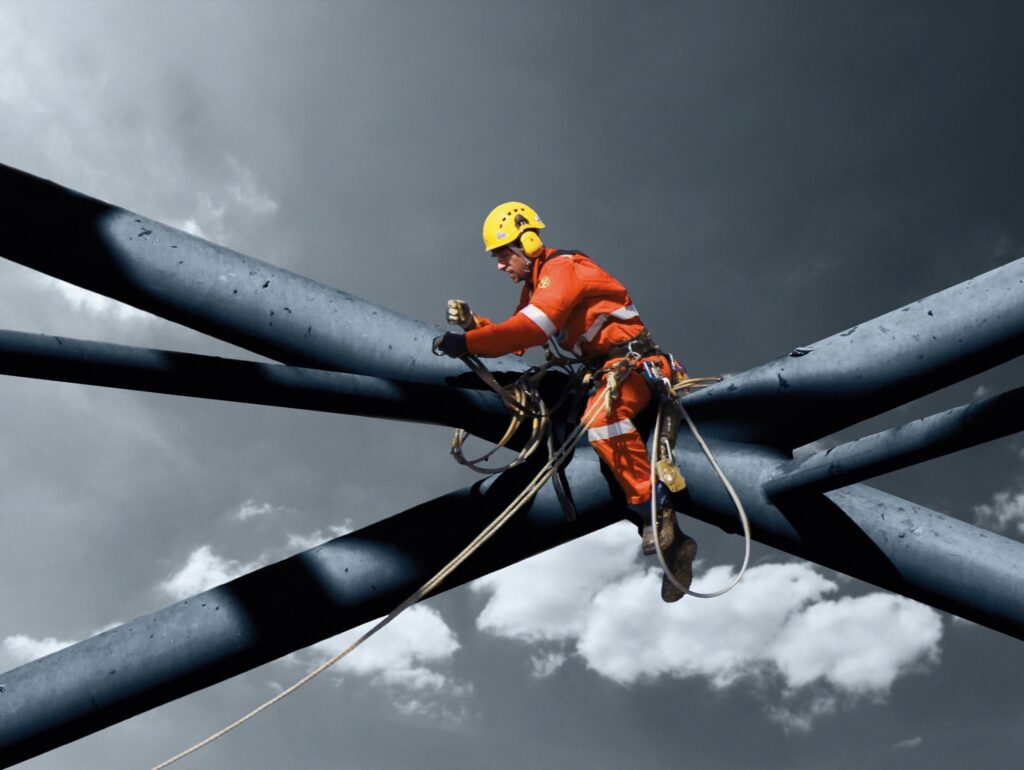
Rope access is faster than traditional scaffolding in virtually all situations where the work location is difficult to reach, the maintenance scope is limited to specific points on a structure, or speed of mobilization is decisive. The greatest time advantage arises because access and execution are in one hand: no separate scaffolder is needed to prepare the work for a technical contractor.
For industrial maintenance and offshore work, a rope access team can usually start on the same day as the survey or inspection. There is no need to deliver and assemble scaffolding materials, no waiting time for a scaffolding team, and no separate approval phase for the construction of the work position itself. The planning and permit documentation relates to the technical work, not to the erection of a temporary structure.
When is the time advantage greatest?
The time advantage of rope access is most pronounced for inspections with immediate repair, emergency repairs to installations in operation, and maintenance on structures where scaffolding is logistically unfeasible. In all of these situations, rope access eliminates the entire pre- and post-phase of scaffolding: delivery, assembly, dismantling, and removal.
For turnarounds, the advantage is structural. A multidisciplinary rope access team that carries out coating, insulation, welding, and NDT inspections in a single scope replaces the combination of a scaffolder plus several technical contractors. Fewer parties on site means less coordination, a shorter lead time, and a faster restart of the installation.
When does rope access offer no speed advantage?
Rope access is less efficient than scaffolding for long-duration work on large continuous surfaces where work is carried out permanently at height, or for lifting weights that structurally exceed 300,000 kilograms. In those cases, a permanent work platform such as a scaffold offers a better basis for execution.
Outside these specific situations, Sky-Access, as an IRATA-certified company, does not compare rope access and scaffolding as stand-alone methods, but rather rope access as an integrated working method against the combination of a scaffolder plus a technical contractor. In most industrial maintenance situations, that comparison comes out in favor of rope access, both in lead time and in total project costs.
Related Articles
- Why is a multidisciplinary team more efficient for maintenance at height?
- What Are the Benefits of Technical Maintenance Without Scaffolding?
- What Are the Most Common Damage Patterns in Wind Turbine Blades?
- What Is the Difference Between an NDT Inspection and a Visual Inspection?
- Sky-Access at great heights: innovative access solutions for the Euromast in Rotterdam

 NL
 EN