The most common damage patterns on wind turbine blades are leading edge erosion, delamination of the composite layers, cracks in the surface coating, lightning strike damage, and damage from bird collisions. Leading edge erosion is by far the most frequently encountered problem and has a direct impact on the turbine's aerodynamic efficiency. This article discusses the main types of damage, their causes, the consequences of delayed repair, and the common repair methods one by one.
Which types of damage most commonly occur on wind turbine blades?
The most common damage patterns on wind turbine blades are leading edge erosion, surface cracks in the gelcoat, delamination of composite layers, lightning strike damage, and mechanical damage from bird collisions or ice accretion. Leading edge erosion is statistically the most widespread and occurs on virtually all turbines after a few years in operation.
Each damage pattern has its own cause and its own rate of progression. Surface cracks in the protective gelcoat initially seem harmless, but they form an entry point for moisture that penetrates deeper into the laminate. Delamination then develops invisibly from the inside out, which makes it more dangerous than damage that is immediately noticeable during a visual inspection. Lightning strike damage is usually concentrated at the tip of the blade, where the lightning receptor is positioned.
- Leading edge erosion: wear of the protective coating or laminate caused by rain, hail, and sand particles
- Surface cracks: cracks in the gelcoat or topcoat caused by thermal stress, fatigue, or impact
- Delamination: separation of composite layers due to moisture ingress or manufacturing defects
- Lightning strike damage: localized burning or explosive damage around the tip and lightning receptor
- Bird collisions and impact: localized dents or fractures caused by mechanical impact
- Ice accumulation: uneven loading and surface damage caused by freezing, particularly onshore
What causes leading edge erosion on a wind turbine blade?
Leading edge erosion on a wind turbine blade is caused by the high kinetic energy of raindrops, hailstones, and sand particles striking the blade tip at speeds of more than 80 meters per second. On offshore turbines and turbines in coastal areas, salt-laden precipitation significantly accelerates this process. The combination of high tip speed and aggressive weather conditions makes leading edge erosion the most universal damage pattern in the wind energy sector.
The erosion process occurs in stages. First, the protective coating or leading edge protection tape wears away. The underlying laminate is then exposed to moisture and impact, leading to pitting and eventually to deep craters in the composite material. As the profile of the leading edge changes, aerodynamic drag increases and energy yield drops noticeably.
Offshore turbines are particularly vulnerable due to the combination of higher average wind speeds, salt-laden precipitation, and the logistical challenge of inspecting and repairing in good time. Onshore turbines in flat, open areas experience similar erosion rates but are generally easier to access for periodic maintenance.
How does delamination occur in wind turbine blades?
Delamination in wind turbine blades occurs when the bond between individual composite layers fails. The most common causes are moisture ingress through cracks or damaged coating, thermal stress caused by temperature fluctuations, and fatigue loading from the cyclic bending of the blade during operation. Manufacturing defects, such as incomplete curing of the laminate or air entrapment during fabrication, can also lay the foundation for delamination that only becomes visible years later.
What makes delamination particularly problematic is that it is invisible in the early stages. A visual inspection of the blade surface is not conclusive; only with non-destructive testing (NDT) such as thermographic or ultrasonic inspection does the extent become visible. Untreated delamination grows due to the continuous mechanical loading of the blade and can ultimately lead to structural failure.
Moisture plays a key role in the progression process. Once water penetrates the laminate through a crack or erosion site, it freezes at low temperatures and widens the gap between the layers. This freeze-thaw cycle significantly accelerates delamination, particularly for turbines in climates with regular periods of frost.
How quickly does blade damage worsen if repair is postponed?
Blade damage worsens exponentially when repair is postponed. What begins as a small crack in the gelcoat or a localized erosion spot on the leading edge quickly develops into deeper laminate damage under the influence of wind, rain, and temperature fluctuations. Every day a turbine operates with unrepaired damage increases the risk of structural failure and significantly raises the eventual repair costs.
The consequences of deferred maintenance are twofold. First, aerodynamic damage increases: a damaged leading edge raises drag and reduces lift, which directly results in energy loss. Second, structural integrity declines as delamination spreads or cracks penetrate deeper. In the worst case, this leads to a section of the blade breaking off, which not only damages the turbine but also poses a safety risk to the surroundings.
From a cost perspective, early intervention is always more economical. A superficial repair of leading edge erosion damage with tape or coating is a relatively limited intervention. A large-scale blade repair or tip replacement after deferred maintenance costs many times more in money and downtime. For offshore turbines, every day of downtime counts directly toward the operating costs of the wind farm.
When is a blade inspection necessary?
A wind turbine blade inspection is necessary when a new turbine is commissioned, after extreme weather events such as severe hailstorms or lightning strikes, and periodically as part of the regular maintenance plan. Industry standards generally recommend a visual inspection at least once a year, supplemented by a detailed NDT inspection when visual abnormalities are observed.
Specific signs that warrant an immediate blade inspection include:
- An unexplained drop in the turbine's energy yield
- Visible damage after a lightning strike or bird collision
- Unusual noises during operation, such as flapping or whistling
- Vibrations that deviate from the normal operating pattern
- Visual abnormalities visible from the ground or via drone inspection
Drone inspections are valuable for detecting surface damage, but they do not replace a full technical inspection. A drone detects; a certified inspector assesses the severity, determines the depth of the damage using NDT techniques, and decides whether immediate repair is necessary. The advantage of a specialized partner such as Sky-Access for offshore wind is that inspection and repair can be combined in a single deployment, which limits downtime and mobilization costs.
Which repair methods are used for wind turbine blade damage?
The repair method for wind turbine blade damage is determined by the type of damage, its depth, and its location on the blade. The most commonly used methods are applying erosion protection tape or a new coating to the leading edge, injecting and filling surface cracks with epoxy or polyurethane, repairing delamination via vacuum infusion, and, in cases of severe structural damage, replacing a section of the blade or the entire tip.
Preventive and minor repairs
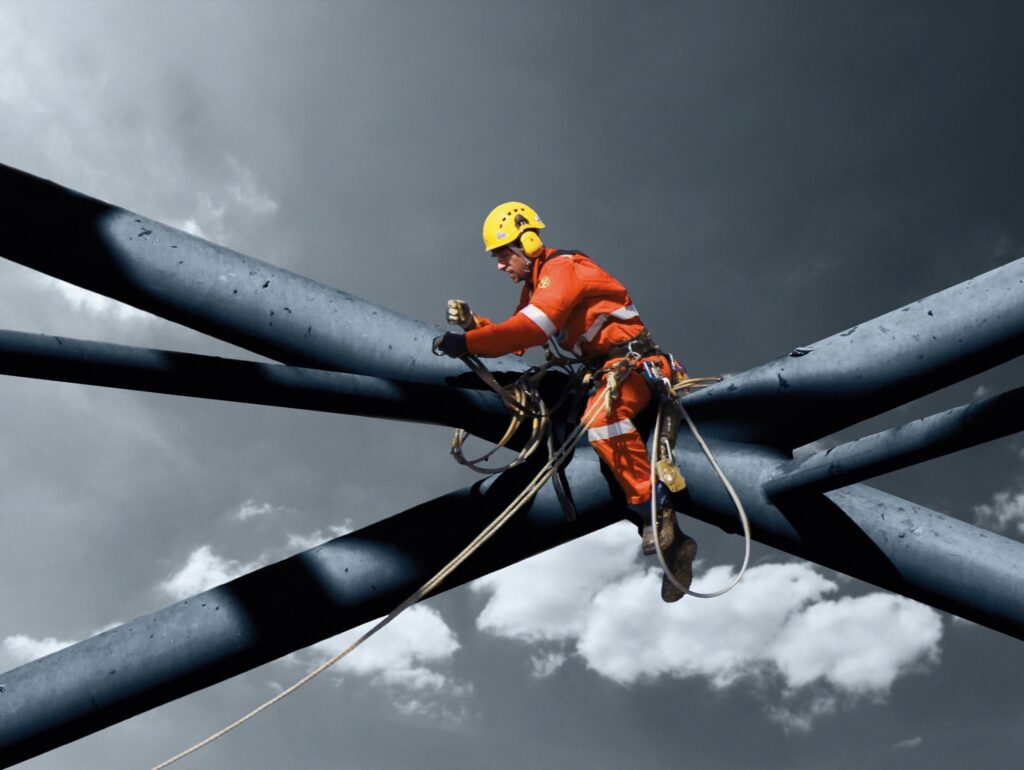
For erosion damage in an early stage, applying erosion protection tape or a new leading edge coating is the most cost-effective solution. This method restores the aerodynamic profile, protects the underlying laminate against further moisture ingress, and significantly extends the blade's service life. Coating and tape can be applied without shutting down the turbine for long periods and can also be carried out offshore via rope access.
Structural repairs and tip replacements
For deeper delamination or severe structural damage, a more extensive repair is required. Damaged composite layers are removed, the underlying structure is restored, and new laminate layers are applied and cured. For damage to the blade tip, a full tip replacement may be the most efficient solution. Offshore, such large-scale repairs have traditionally depended on jack-up or crane vessels, which drives costs up sharply.
For this type of offshore repair, Sky-Access has developed a patented modular blade platform that is assembled around the tower and positioned at the optimal working height using electric winches. This system makes large-scale blade repairs and tip replacements at sea possible without a crane vessel, with cost savings of more than €100,000 per deployment compared to a crane vessel operation. More about this approach can be found on the Sky-Access website.
Regardless of the repair method, the quality of workmanship determines the lifespan of the repair. Air humidity, temperature, and surface preparation are critical parameters that must be continuously monitored during the repair to ensure that the coating and laminate bond correctly and achieve their expected service life.
Related Articles
- Which method is safest for working at height?
- How Is Maintenance Carried Out on Hard-to-Reach Industrial Installations?
- What Is Technical Maintenance at Height in Industry?
- What Is the Difference Between an NDT Inspection and a Visual Inspection?
- Sky-Access at great heights: innovative access solutions for the Euromast in Rotterdam

 NL
 EN