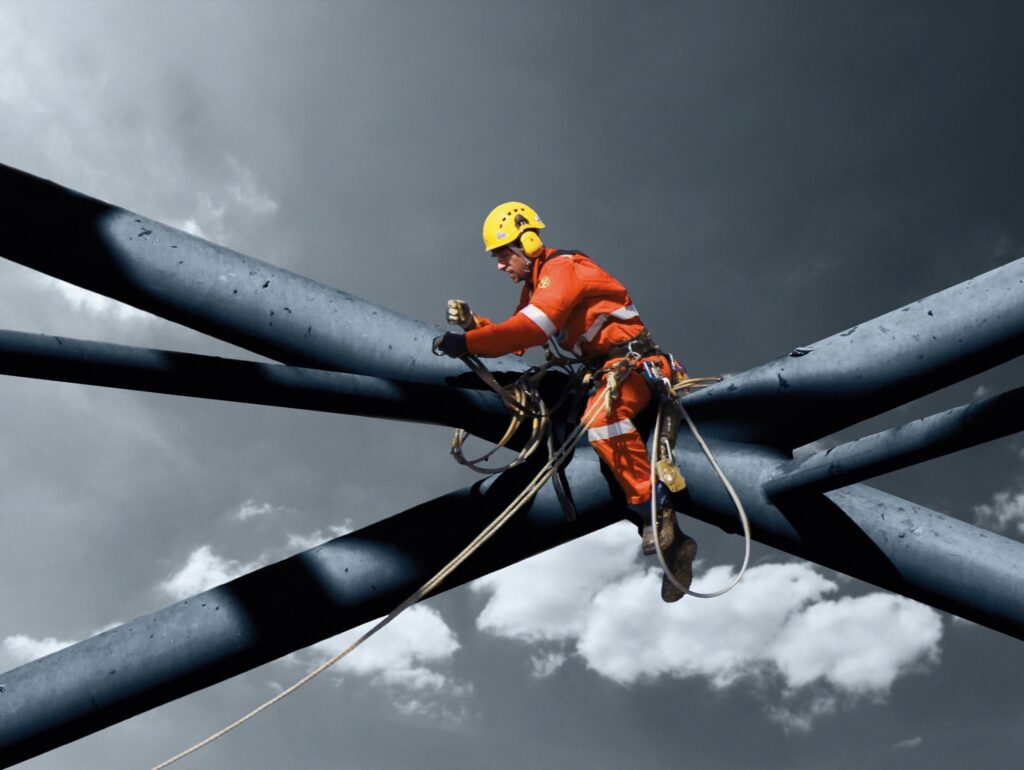
Maintenance on hard-to-reach industrial installations is carried out using specialized access techniques such as rope access, in which certified technicians combine access and technical execution in one integrated approach. The key to efficient maintenance at height or in confined spaces is using a method that combines access and craftsmanship, so that installations are out of service for as short a time as possible. The following questions cover everything from choosing a method to safety requirements.
Which methods are used for maintenance in hard-to-reach locations?
Three main methods are used for maintenance on hard-to-reach industrial installations: traditional scaffolding, industrial rope techniques (rope access), and specialized suspended platforms. The choice depends on the location, the type of work, the available anchor points, and the desired lead time. In most industrial situations, rope access is the most flexible and cost-efficient option.
Traditional scaffolding provides a stable work platform, but it takes a lot of time to erect and dismantle, occupies physical space on the site, and often blocks driving routes and loading and unloading positions. For large-scale shell construction projects where work at height is structural and long-term, scaffolding remains more efficient. But for the majority of industrial maintenance, inspections, and repairs on hard-to-reach installations, it is a logistically heavy solution.
Aerial work platforms are suitable for lower working heights in open environments, but are not an option when the ground cannot bear the weight, the space is too tight, or the structure is offshore or at height. In those cases, rope access offers a practical alternative that mobilizes quickly and has virtually no footprint on the site.
Specialized suspended platforms, such as the modular SkyDeck platform, fill the gap between rope access and traditional scaffolding. They are used on structures such as bridges, locks, and offshore helidecks, where a suspended work platform is necessary but a full scaffold is not logistically or structurally feasible.
How does a rope access maintenance project work, step by step?
A rope access maintenance project begins with a technical survey of the location, followed by the setup of a rope system by an IRATA level 3 supervisor, execution of the technical work by certified specialists, on-site quality control, and completion with documentation and handover. The strength of rope access is that inspection and repair can often take place on the same day.
In the preparation phase, the anchor points are identified and tested, the work method is recorded in a task risk analysis, and the required materials and specialists are planned. Because rope access teams are compact and bring little equipment, mobilization time is considerably shorter than with scaffolding.
During execution, the technicians work with a two-point system: always attached to two independent rope lines. The IRATA level 3 supervisor is responsible for rope safety and for setting up the rope system. The technical work, such as welding, coating, or inspecting, is carried out by trade specialists with the right technical background. Sky-Access applies the following principle: teach a welder to climb, not a climber to weld.
Quality assurance takes place continuously. For coating and preservation work, humidity measurements are taken daily, coating thickness measurements are documented, and pull-off tests are performed on the new coating. This is all the more relevant because clients find it difficult to inspect work at height themselves.
What is the difference between rope access and traditional scaffolding?
The core difference is that a scaffolder only supplies a work platform, whereas rope access combines access and technical execution in one team. A scaffolder plus a separate technical contractor together form the comparable combination, not the scaffolder alone. Rope access eliminates the intermediate layer and thereby delivers a shorter lead time, less equipment on site, and less coordination effort.
In logistical terms, scaffolding has a major impact on the site. It blocks driving routes, loading and unloading positions, and access roads, which causes direct operational disruption on busy industrial sites. Rope access has virtually no impact on the surroundings: the team mobilizes compactly, works from anchor points above or beside the structure, and leaves site logistics intact.
From a safety perspective, research shows that rope access has statistically fewer fatal incidents than scaffolding work. On scaffolds, fitters regularly unclip themselves to move more freely, which increases fall risk. Rope access technicians are attached at all times via a two-point system and cannot leave the rope system without a deliberate action.
In terms of cost: the hourly rate of a certified rope access company may be slightly higher than that of a scaffolder. But the right comparison is the total price: a scaffolder plus a technical contractor combined versus a single rope access team that carries out the entire scope. In most industrial situations, that comparison favors rope access, because the lead time is shorter and installations return to operation sooner.
Which technical work can be carried out via rope access?
Via rope access, virtually all technical maintenance work that is also performed using traditional methods can be carried out, including welding, NDT inspections, blasting and painting, insulation work, corrosion investigation (including corrosion under insulation), tank maintenance, assembly and disassembly, and fire protection measures. Rope access is not a limited method, but a full-fledged means of access for technical craftsmanship at height and in confined spaces.
- Mechanical engineering: welding, repairing, assembling, and disassembling structures and installations at height or in confined spaces.
- Blasting and painting: surface treatment of steel structures, offshore platforms, and industrial installations in accordance with ISO 12944.
- Insulation and corrosion under insulation (CUI): applying and repairing insulation on pipes, tanks, and boilers, including investigation of corrosion under existing insulation.
- Non-destructive testing (NDT): inspections in which the structure remains intact, including in hard-to-reach or confined spaces.
- Tank maintenance: inspection and repair work on industrial tanks, gas holder tanks, and storage tanks, using a patented Mono Arm for the walls.
- Fire protection measures: applying and repairing fire-resistant coatings and materials on steel structures.
- Industrial cleaning: cleaning of confined spaces, tanks, and industrial installations.
An important distinguishing feature of a multidisciplinary rope access team is that coating, insulation, NDT, and welding are carried out by one team. This avoids the logistical complexity of multiple contractors visiting the same hard-to-reach location one after another.
When is rope access the best choice for industrial maintenance?
Rope access is the best choice for industrial maintenance when the location is difficult or costly to reach with scaffolding or aerial work platforms, when speed of mobilization and minimal downtime are decisive, or when the footprint on the site must be kept limited. In turnaround situations, offshore environments, and on hard-to-reach structures, rope access offers structural advantages.
Specific situations in which rope access is preferable:
- Installations at height in petrochemical plants where scaffolding blocks driving routes or process installations.
- Offshore platforms and wind turbines where mobilization time and minimal footprint are decisive procurement factors.
- Structures such as bridges, locks, and helidecks where traditional scaffolding is not logistically feasible.
- Urgent maintenance or emergency repairs where work must start immediately after an inspection.
- Urban environments where the ground cannot bear the weight of an aerial work platform or where there is no space for a scaffold.
- Tank maintenance where conventional scaffolding takes weeks and rope access reduces this to days.
Rope access is less suitable for long-term work on large continuous surfaces in shell construction situations, such as bricklaying an apartment building, where work at height is permanent and scaffolding is more efficient. For structural lifting weights above 300,000 kg, too, other methods are called for. Outside these exceptions, rope access in industry and offshore is the most versatile and cost-efficient access method.
What safety requirements apply to maintenance via rope access?
Strict safety requirements apply to rope access maintenance at both the statutory and sector level. Dutch law requires proper training in which rescuing colleagues is central, and sufficient supervision during execution. On top of that, the IRATA standard adds an internationally recognized quality system that includes company certification, periodic audits, and mandatory incident registration.
IRATA company certification as a distinguishing mark of quality
Many rope access companies work with IRATA-certified technicians but are not themselves certified as a company. This is a crucial distinction: a non-certified company is not supervised by the international IRATA organization and is not obliged to report incidents. An IRATA-certified company is fully audited every three years, has all climbing equipment and procedures recorded in a controlled system, and works exclusively with certified technicians at level 1, 2, or 3.
An IRATA level 3 supervisor is required to be present on every job. This supervisor is responsible for rope safety and for setting up the rope system. For HSE managers and procurement officers, this is a demonstrable safety guarantee that makes the difference in tenders and permit procedures. A serious client always chooses an IRATA-certified company, not just a company with certified personnel.
Equipment and rescue systems
Safety starts with inspected and periodically checked equipment. Cheap providers sometimes have technicians work with their own ropes and harnesses, which calls inspections and liability into question. A certified rope access company works exclusively with its own, periodically certified equipment that falls under the company quality system.
In addition to the technical execution, the rope access team also acts as a rescue team for work in confined spaces. The specialists are trained in rescue techniques and in setting up rescue systems, so that your own staff or third parties can be evacuated quickly and safely in the event of an incident. This is a statutory obligation for confined spaces and a practical advantage of rope access over methods in which the rescue team has to be organized separately.
More information about Sky-Access's approach and certifications can be found on the about us page.
Related Articles
- What Does Industrial Maintenance at Height Cost on Average?
- What Is the Difference Between Maintenance With and Without Scaffolding?
- What Is Technical Maintenance at Height in Industry?
- What Is the Difference Between Onshore and Offshore Wind Turbine Maintenance?
- What Is the Difference Between an NDT Inspection and a Visual Inspection?

 NL
 EN