Offshore wind turbine maintenance differs fundamentally from onshore maintenance in complexity, logistics, and cost. The offshore location makes access harder, weather conditions more unpredictable, and downtime more expensive. For technical teams, this means that every decision about access method, planning, and safety carries more weight than on land. This article answers the most frequently asked questions about the difference between onshore and offshore wind turbine maintenance.
Why is offshore wind turbine maintenance more complex than onshore?
Offshore wind turbine maintenance is more complex than onshore maintenance because every task at sea requires additional logistical steps. Personnel and equipment must be transported by service vessel or helicopter, the weather window determines when work can be carried out, and there is no direct fallback to a nearby workshop or warehouse. This makes preparation and planning more critical than with onshore turbines.
With onshore turbines, access is relatively simple: a technician drives to the site, parks their equipment, and starts working. Offshore, a very different reality applies. Working days always last twelve hours, and for safety reasons work is carried out exclusively in daylight. That limits the effectively usable time per day, especially in the winter months.
In addition, offshore turbines are generally larger than their onshore equivalents, with longer blades, taller towers, and a more heavily loaded nacelle. This increases the technical scope of every maintenance job. Leaks at the collar, the ring between nacelle and rotor, do occur and require both repair and cleaning of the tower. Leading edge corrosion on the blades, lightning strikes, and bird collisions are typical forms of damage that must be dealt with offshore under more difficult conditions than on land.
Which access methods are used in wind turbine maintenance?
Three main methods are used in wind turbine maintenance: internal access via the tower and nacelle, external access via a crane vessel or work platform, and rope access using trained rope specialists. The choice depends on the nature of the work, the location of the damage, and the infrastructure available on and around the turbine.
Internal access via the tower is standard for mechanical and electrical work in the nacelle. For external work on the blades or the outside of the tower, other solutions are needed. Onshore, aerial work platforms or mobile cranes are sometimes used for this, but offshore that is hardly feasible logistically.
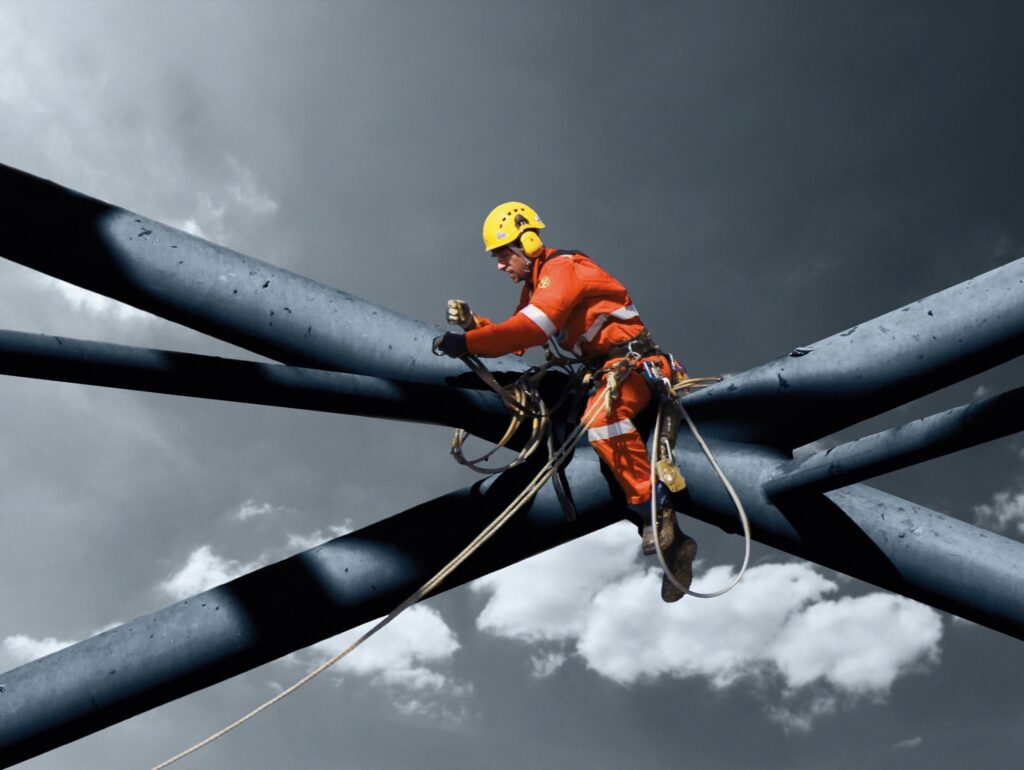
Offshore, rope access is the most flexible and cost-efficient method for external work. Specialized rope technicians reach the blades, the tower, and the nacelle without the need to mobilize heavy equipment. For larger repairs and tip replacements at sea, Sky-Access has developed a patented blade platform: a modular, electrically driven work floor that is positioned along the blade at the optimal working height. In many cases this makes a crane vessel unnecessary, saving more than one hundred thousand euros per deployment.
How does the safety approach differ between onshore and offshore maintenance?
The safety approach for offshore wind turbine maintenance is stricter than onshore, because the consequences of an incident at sea are greater. Evacuation takes longer, medical help is farther away, and environmental conditions are less controllable. This translates into stricter certification requirements, more mandatory safety protocols, and a higher threshold for permitted methods and personnel.
Rope access is statistically the safest method for working at height. Whereas technicians on scaffolding regularly unclip themselves to gain freedom of movement, rope access technicians are secured at all times via multiple anchor points. On every job, an IRATA level 3 supervisor is required to be present, who is responsible for rope safety and for setting up the rope system.
The difference between onshore and offshore also lies in the requirements that clients place on subcontractors. Offshore operators demand demonstrable certification, detailed risk analyses, and proof of incident registration. Companies that are IRATA-certified as a company, such as Sky-Access, are supervised by the international IRATA organization and are required to log all hours and incidents. This sets them apart from companies that deploy IRATA-certified personnel but are not themselves certified as a company.
What are the biggest cost items in offshore versus onshore turbine maintenance?
The biggest cost items in offshore wind turbine maintenance are mobilization, access to the turbine, and downtime. Onshore, these costs are considerably lower: personnel and equipment are quickly on site, weather delays are less disruptive, and the turbine can usually be brought back into operation faster. Offshore, each of these factors weighs more heavily because of the logistical complexity at sea.
For onshore turbines, the main cost items are labor, material costs, and the duration of downtime. The longer a turbine stands idle, the more revenue the operator loses. Fast mobilization and efficient execution are therefore also very important onshore.
Offshore, there are additional costs for vessel transport, weather windows, and the larger amount of equipment that must be brought to the site in advance. Material delivered before a job incurs extra rental costs. Deploying a crane vessel for blade repairs is one of the most expensive options: the cost of such a deployment quickly exceeds one hundred thousand euros. Rope access with a specialized blade platform avoids this cost item entirely.
How is downtime limited in wind turbine maintenance?
Downtime in wind turbine maintenance is limited by combining inspection and repair in a single deployment wherever possible, by mobilizing quickly, and by using methods that do not require a long setup time. Every day a turbine stands idle costs the operator revenue directly, so reducing lead time has an immediate financial impact.
A common mistake is to separate inspection and repair into two distinct moments. When an inspection identifies damage but the repair team is only mobilized later, the turbine stands idle unnecessarily long. Teams that carry out inspection and repair in a single deployment avoid that delay. In the wind energy sector, Sky-Access can usually start repairs on the same day as the inspection, which significantly shortens downtime.
Onshore, fast mobilization is relatively easy to achieve. Offshore, this requires more preparation: equipment and personnel must be available at the right time and the weather window must be used. Modular access systems that can be set up quickly, such as the Sky-Access blade platform, contribute to a shorter lead time because they do not require heavy crane capacity.
When is rope access the best choice for wind turbine maintenance?
Rope access is the best choice for wind turbine maintenance when the work takes place on the outside of the turbine, the damage needs to be reached quickly, and deploying heavy equipment would be disproportionately expensive or logistically unfeasible. This applies both onshore and offshore, but the advantage of rope access is greatest offshore because of the high cost of alternative access methods.
Typical applications for which rope access is the preferred method include:
- Inspection and repair of leading edge corrosion, using tape or coating as the repair method
- Inspection of lightning protection systems in the blades
- Repair of minor damage caused by lightning strikes or bird collisions
- Inspection and repair of the collar between nacelle and rotor, including cleaning of the tower in case of oil leaks
- Major blade repairs and tip replacements offshore via a specialized blade platform
Rope access combines access and technical execution in a single team. Where a scaffolder only supplies the platform and a separate technical contractor carries out the work, a rope access specialist brings their own means of access and carries out the work directly. This shortens lead time, reduces the coordination burden, and lowers total project costs. For wind farm managers and O&M contractors who want to minimize downtime, that is a decisive advantage. More about the use of rope access in the offshore sector can be found on the Sky-Access website.
Related Articles
- When is technical maintenance without scaffolding the better choice?
- What Are the Most Common Damage Patterns in Wind Turbine Blades?
- How does a blade repair on an offshore wind turbine work?
- How Long Does Maintenance on an Industrial Tank Take on Average?
- Why does erecting scaffolding take so much time in industrial maintenance?

 NL
 EN