An offshore wind turbine blade repair broadly follows four phases: inspection to map the damage, surface preparation, application of the repair material, and finishing and quality control. The exact approach depends on the type and extent of the damage, the location on the blade, and the weather conditions at sea. This article answers the most frequently asked questions about the process, from damage identification to the choice between repairing and replacing.
What damage most commonly occurs on offshore turbine blades?
The most common types of damage to offshore wind turbine blades are leading edge erosion, bird strikes, lightning strikes, and surface cracks in the laminate structure. Leading edge erosion is by far the most common: the front of the blade is continuously exposed to rain, salt, sand, and high tip speeds, which gradually wears down the material.
Offshore turbines have a tougher time than their onshore counterparts. The combination of higher wind speeds, salty sea spray, and the larger rotor diameters of modern offshore turbines means that the tip speed at the outer meters of the blade is extremely high. At those speeds, even a raindrop hits like a hard blow, causing the gelcoat and the underlying composite material to crumble over time.
Besides leading edge erosion, these are the most common types of damage:
- Lightning strikes: damage to the tip zone and the internal lightning protection system
- Bird strikes: localized impact damage, often at the tip or the upper third of the blade
- Surface cracks and delamination: cracks in the coating or laminate, sometimes caused by manufacturing defects that only manifest later
- Wet cores: water ingress through small cracks that compromises the blade's sandwich structure
Each of these types of damage has a direct effect on the aerodynamic performance of the blade. Leading edge erosion alone can noticeably increase the energy loss per turbine, which underlines the urgency of timely maintenance.
How is damage to an offshore wind turbine blade detected?
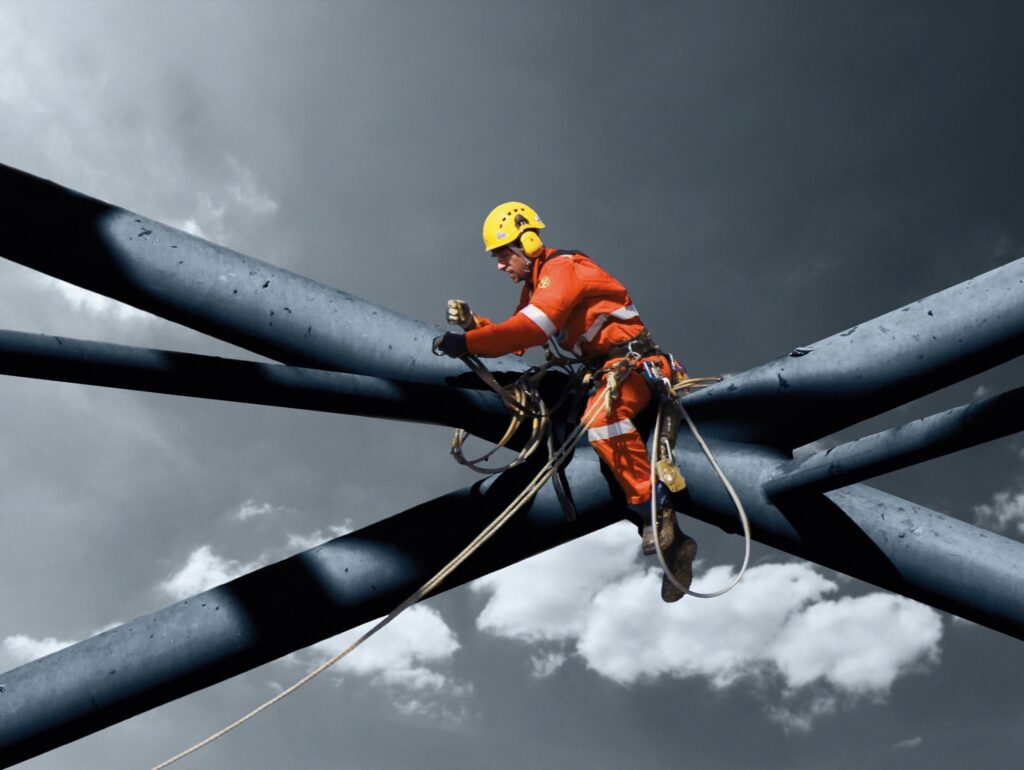
Damage to an offshore wind turbine blade is detected through visual inspection by trained technicians, supplemented by drone inspection for an initial remote survey. On-site visual inspection by a rope access specialist remains the most reliable method for assessing the severity and depth of damage, because a drone can observe but cannot measure or touch.
Drones are increasingly used as the first step in the inspection process. They can quickly provide an overall picture of the condition of all blades without a technician having to climb. But a drone cannot measure the depth of a crack, detect wet cores, or assess the structural integrity of the laminate. As soon as a drone detects an anomaly, a qualified technician must examine the damage up close to determine whether and how it should be repaired.
In a full blade inspection by a rope access team, the blade is assessed systematically from root to tip. The technician checks the leading edge for erosion, inspects the lightning receptors, looks for surface cracks, and assesses the coating for blistering or delamination. When wet cores are suspected, additional non-destructive testing (NDT) can be used, such as thermography or tap testing.
An important practical advantage of rope access for offshore blade inspection is that inspection and repair can take place on the same day. Once the damage has been mapped and the repair decision has been made, the team can start the work immediately, without the turbine having to be shut down again for a second mobilization.
How does the repair proceed step by step?
An offshore wind turbine blade repair proceeds in five steps: safely positioning at the blade, cleaning and roughening the damaged surface, applying the repair material, curing and finishing, and finally quality control. The exact execution differs per type of damage, but the sequence is always the same.
- Positioning and safety setup: The repair team reaches the blade via rope access or via a specialized blade platform. The turbine is stopped and locked out. The technicians set up their rope system, with an IRATA level 3 supervisor always responsible for rope safety.
- Cleaning and surface preparation: The damaged area is thoroughly cleaned, degreased, and mechanically roughened. In the case of leading edge erosion, the affected material is removed down to the sound substrate. Good surface preparation determines adhesion and therefore the lifespan of the repair.
- Applying the repair material: Depending on the extent of the damage, work is done with protective tape, liquid coating, or a full laminate repair with epoxy and glass fiber fabric. For leading edge erosion with lighter damage, a high-quality polyurethane tape or coating is often applied; for deeper erosion or structural damage, a laminate repair follows.
- Curing and finishing: The repair material must cure under the right conditions. Temperature and humidity are measured and documented throughout the entire process. After curing, the repair is sanded smooth and finished until the aerodynamic profile of the blade is restored.
- Quality control: The completed repair is visually inspected and documented. For coating repairs, layer thickness measurements are carried out. The findings are recorded in a repair report that is handed over to the client.
Offshore working days are standardly 12 hours. All work on the blade is carried out exclusively in daylight because of the safety requirements that apply to rope access at sea.
What is the difference between rope access and a crane or platform for blade repair?
The biggest differences are cost and mobilization time. Deploying a crane vessel for offshore blade repair is a complex, expensive operation that requires weeks of planning and costs more than a hundred thousand euros extra compared to rope access. Rope access teams can mobilize faster, work with a minimal footprint, and carry out inspection and repair in a single deployment.
A crane vessel or jack-up vessel does offer a stable working platform, but the logistics are heavy: the vessel must be booked, scheduled, and sailed to location, and weather conditions determine whether and when work can be done. For large-scale replacements or tip changes, a crane may be necessary, but for most repairs it is not.
For offshore blade repairs where a stable working platform is needed but a crane vessel is too costly, Sky-Access has developed a patented blade platform: a modular, electrically operated work floor that is attached directly to the blade. This system provides a stable work surface for larger repairs and tip changes, saving more than €100,000 per deployment compared to a crane vessel.
Rope access without a platform is the most flexible method for small and medium-sized repairs. The technicians position themselves along the blade via rope systems and can reach virtually any position, even at the most remote offshore locations. The combination of low footprint, rapid deployability, and the ability to combine inspection and repair in a single visit makes rope access the most efficient choice for the vast majority of blade repairs.
How long does a blade repair on an offshore wind turbine take?
A standard blade repair on an offshore wind turbine typically takes one to three working days per blade, depending on the type of damage, the size of the damaged zone, and the weather conditions. A simple leading edge treatment with tape or coating can be completed in one day; an extensive laminate repair with full surface preparation and curing time requires more time.
The total downtime of the turbine also depends on planning. If inspection and repair are combined in the same deployment, which is standard with rope access, the turbine is shut down only once. That is a substantial advantage over a approach in which an inspection company first establishes the damage and a separate repair company is then mobilized.
Weather conditions are always a determining factor offshore. Rope access work is carried out exclusively in daylight and within the applicable wind speed limits. A well-planned deployment takes the weather window into account and aims to treat all blades of one turbine within a single weather window, so that the turbine is idle for as little time as possible.
When is replacing a blade better than repairing it?
Replacing a wind turbine blade is better than repairing it when the structural integrity of the blade has been compromised to such an extent that repair can no longer restore its original strength and lifespan. This is the case with severe delamination over large areas, deep cracking in the main spar, or persistent wet cores that have damaged the foam material.
The trade-off between repairing and replacing is primarily a technical and economic decision. From a technical standpoint, repair makes sense as long as the blade, after restoration, meets the original specifications for strength, stiffness, and aerodynamic profile. From an economic standpoint, the remaining lifespan of the turbine plays a major role: an extensive repair on a turbine that will be replaced in three years anyway is less attractive than on an installation that still has to last ten to fifteen years.
Practical indicators that argue for replacement rather than repair:
- Damage to the main spar or the root connection of the blade
- Multiple previous repairs at the same location that have failed again
- Wet core over more than a certain percentage of the blade surface, as established by NDT
- Damage that structurally affects the balance of the rotor and cannot be corrected
In practice, repair is the right choice for the vast majority of damage cases. Most leading edge erosion, bird strikes, and surface cracks are readily repairable, especially when they are detected in time through regular offshore blade inspection. Postponing maintenance increases the likelihood that repairable damage grows into a situation in which replacement becomes unavoidable, which significantly increases total costs.
Related Articles
- How to Minimize Downtime in Industrial Maintenance?
- What Are the Benefits of Technical Maintenance Without Scaffolding?
- How do you know if a maintenance company has the right certifications?
- What are the risks of working at height in the petrochemical industry?
- How Long Does Maintenance on an Industrial Tank Take on Average?

 NL
 EN