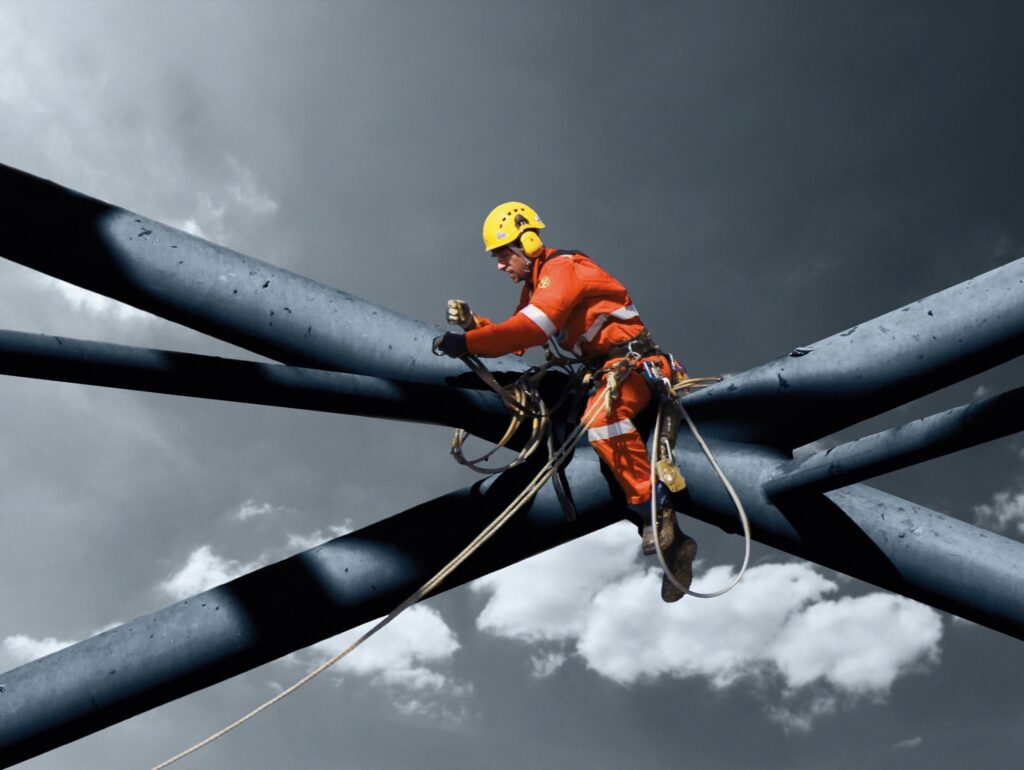
Working at height in the petrochemical industry carries serious risks: fall hazards, exposure to hazardous substances, explosive atmospheres and extreme working conditions combine to create a complex safety profile that demands specialized knowledge, strict procedures and demonstrable certification. These risks apply to everyone who works at height on industrial installations, from fitters and welders to NDT inspectors. The questions below cover the most critical aspects of working at height safely in the petrochemical industry.
What hazards are specific to working at height in the petrochemical industry?
Working at height in the petrochemical industry combines the general hazards of work at height with the specific risks of an industrial environment: explosive and toxic atmospheres, extreme temperatures, corroded surfaces and the presence of pressurized pipes and installations. This makes the risk profile considerably more complex than working at height in other sectors.
In petrochemical installations, fitters regularly work above or next to live processes. A fall is therefore dangerous not only because of the fall energy itself, but also because of where a person may end up. Think of hot surfaces, pipes carrying hazardous media, or low-lying spaces with insufficient oxygen.
Corrosion also plays a major role. Pipes and structures that have been exposed to temperature fluctuations and damp conditions for years can be unexpectedly unstable. Corrosion under insulation, known in the industry as CUI, is a common and underestimated hazard: the degradation is not visible from the outside, but it can seriously compromise the load-bearing capacity of a structure or support point. A fitter who secures themselves to a corroded anchor point runs a real risk.
Explosion hazard is another characteristic feature of the petrochemical industry. In zones where flammable gases or vapors may be present, strict ATEX classifications apply that determine which tools, equipment and working methods are permitted. Sparks from welding, grinding or even static electricity can have catastrophic consequences in these environments.
What are the most common causes of fall incidents in industrial environments?
The most common causes of fall incidents during industrial work at height are unhooking from personal fall protection, defective anchor points, insufficient training, and the use of access equipment that is unsuitable for the specific working situation. In most cases, human behavior plays a decisive role.
One pattern that recurs repeatedly in practice is temporarily unhooking from the fall protection line. On scaffolding, fitters regularly unhook themselves because constantly clipping on and off when moving across a platform is perceived as cumbersome. This seemingly minor convenience is responsible for a significant share of fatal fall incidents in the industry.
Defective anchor points are a second structural cause. In petrochemical environments, structures are sometimes decades old. Anchor points that look solid can be severely weakened by corrosion or fatigue. Without systematic inspection and testing of anchor points before work begins, there is a real risk that personal fall protection will fail at the moment it is needed most.
Insufficient or inadequate training is a third factor. Working at height requires more than wearing a harness. Fitters must understand how to set up a fall protection system correctly, how to assess an anchor point and how to act in the event of an incident. When this awareness is lacking, routine actions unwittingly become risky. With rope access, this risk is structurally lower, because technicians work exclusively with methods that require permanent securing at multiple attachment points.
How is the risk of working at height in the petrochemical industry assessed?
The risk of working at height in the petrochemical industry is assessed through a structured risk assessment, also known as a task risk analysis (TRA) or Job Hazard Analysis (JHA). It systematically maps out the specific working conditions, the access method, the environmental risks and the competencies of the team carrying out the work before the work begins.
A complete risk assessment for work at height in the petrochemical industry includes at least the following elements:
- Identification of fall risks: height of the workplace, presence of protective measures, quality of anchor points and the free fall clearance below the worker
- Environmental risks: ATEX zone classification, presence of hazardous substances, temperature and weather conditions
- Structural integrity: assessment of the condition of the structure, anchor points and any scaffolding elements
- Competence level: verification of the certification and experience of all personnel involved
- Rescue plan: documentation of how a fallen worker can be evacuated quickly and safely
One point that regularly receives too little attention in practice is the rescue plan. Dutch legislation requires employers not only to prevent fall incidents, but also to have a demonstrable and workable rescue plan in place. A worker hanging in a harness after a fall can lose consciousness within minutes due to orthostatic intolerance. Rapid evacuation is then literally a matter of life and death.
Which certifications and standards apply to working at height safely?
The most important certifications and standards for working at height safely in the petrochemical industry are: VCA-P for companies operating in the petrochemical sector, IRATA certification for rope access work, and ISO 9001 for quality management. In addition, European standards such as EN 363 for personal fall protection systems and the ATEX directives for explosive atmospheres apply directly.
VCA-P is the highest level of the Safety, Health and Environment Checklist for Contractors and is specifically required for contractors active in the petrochemical industry. It differs from other VCA levels through additional requirements in the areas of safety management, audit frequency and the breadth of the certified activities. Clients in the petrochemical industry generally treat VCA-P as a hard procurement requirement.
For rope access work, the IRATA standard is the international benchmark. IRATA sets requirements both for individual technicians, through a three-level structure from Level 1 to Level 3, and for companies as a whole. A crucial distinction in the market is that many companies deploy IRATA-certified fitters but are not themselves certified as a company. An IRATA-certified company is supervised by the international IRATA organization, is required to log all hours and incidents, and is periodically audited externally. That makes a substantial difference for clients who need demonstrable safety guarantees in tenders and permit procedures.
Sky-Access holds VCA-P certification, IRATA company certification (number 5025/0) and ISO 9001. More information about the company's working methods and certification background can be found on the About us page of Sky-Access.
Why does rope access have a lower incident rate than traditional scaffolding?
Rope access statistically has a lower incident rate than traditional scaffolding because rope access technicians are secured via multiple attachment points at all times and never have the option of unhooking themselves without a deliberate, multi-step action. On scaffolding, unhooking from the fall protection line is an everyday behavior that leads to fatal fall incidents.
The difference lies not only in the technique, but also in culture and supervision. With rope access according to the IRATA standard, an IRATA Level 3 supervisor must be present on every job. This supervisor is responsible for the rope-related safety of the entire job, including setting up the rope system and ensuring that all team members are correctly secured. This structural supervision is missing from many traditional work-at-height operations.
Rope access technicians are also trained in rescue techniques. The team carrying out the work also serves as the rescue team. This means that in the event of an incident, the right people with the right equipment are immediately on hand to evacuate quickly and safely, without waiting for external emergency services.
Finally, preparation for rope access is structurally more intensive. Every rope system is set up and checked by the Level 3 supervisor before work begins. Anchor points are assessed for load-bearing capacity and integrity. There is no conceivable situation in which a fitter "quickly" skips an anchor point or postpones a check.
How does a specialized access partner reduce the risks on your project?
A specialized access partner reduces the risks on a work-at-height project by bringing access and technical execution together under one roof, guaranteeing certified supervision, and structurally minimizing workers' exposure to hazardous situations. Choosing a partner with demonstrable certification and multidisciplinary expertise lowers both the safety risk and the coordination burden for the client.
A common comparison in the industry is the one between rope access and scaffolding. But the right comparison is this: a scaffolding contractor plus a separate technical contractor, versus a specialized rope access partner that combines both roles. When access and execution sit with two different parties, coordination risks arise: unclear responsibilities, differing safety cultures and more people on site than strictly necessary.
A specialized partner such as Sky-Access brings multidisciplinary teams that can carry out the full scope: from welding and NDT inspections to blasting and painting work and the application of corrosion-resistant coating systems. One team, one point of contact, one safety culture. This not only reduces the likelihood of miscommunication, but also shortens lead times, which in the petrochemical industry translates directly into lower downtime costs.
For projects where conventional access is logistically unfeasible or too costly, Sky-Access also offers the modular SkyDeck platform as an alternative to suspended scaffolding. This system is lighter, quicker to assemble and does not require closing off traffic routes or loading and unloading areas on the plant site.
For clients in the petrochemical industry, the heart of the decision is not the hourly rate, but the total project cost and the safety record of the contractor. Companies that demonstrably comply with VCA-P, IRATA company certification and ISO 9001 offer a verifiable level of safety that makes the difference in tenders and permit procedures. Want to know more about Sky-Access's approach in the industry and offshore sector? That page explains how the company tackles complex projects in demanding environments.
Related Articles
- How to Minimize Downtime in Industrial Maintenance?
- What Is the Difference Between Maintenance With and Without Scaffolding?
- How Is Technical Maintenance Carried Out on Industrial Installations?
- Why does erecting scaffolding take so much time in industrial maintenance?
- How do you know if a maintenance company has the right certifications?

 NL
 EN