Technical maintenance without scaffolding is the better choice when the location is difficult to reach for conventional scaffolding, when a short turnaround time is crucial, or when the combined costs of a scaffolding contractor and a technical contractor do not outweigh those of an integrated rope access approach. For industrial clients in petrochemicals, offshore and wind energy, rope access is in most cases not only more practical but demonstrably cheaper. This article answers the most frequently asked questions about when scaffold-free maintenance is the right choice and how to weigh that decision.
In which situations does traditional scaffolding fall short?
Traditional scaffolding falls short when physical access to a work location makes erecting a scaffold logistically impossible or economically unjustifiable. This applies to work on the underside of bridges, offshore structures, spherical tanks, silos, slender industrial columns and urban façades where no ground space is available for a scaffold base.
But even at locations where a scaffold can be built, there are structural drawbacks. Scaffolds occupy traffic routes, loading and unloading positions and access roads on an industrial site. In the petrochemical industry, where dozens of contractors operate at the same time during a turnaround, this leads to logistical bottlenecks that extend the total duration of the shutdown. Every extra day of downtime costs a plant money.
In addition, scaffolding always requires two separate parties: a scaffolding contractor who builds the workplace, and a technical contractor who carries out the work. That split brings coordination overhead, extra planning risk and double mobilization costs. With rope access, access and execution are integrated in a single team.
What are the advantages of rope access over scaffolding?
Rope access combines access and technical execution in one specialized team, without the logistical footprint of a scaffold. The main advantages are a shorter turnaround time, lower total costs, minimal disruption to the surroundings and statistically the lowest incident rate of all methods for working at height.
Cost efficiency through an integrated approach
The right comparison is not "rope access versus scaffolding", but rope access versus the combined costs of a scaffolding contractor plus a technical contractor. Rope access eliminates the scaffolding contractor entirely: the rope access specialist is the technician who brings their own means of access. That means one point of contact, one contract and no waiting time between erection and execution. The savings do not come from a lower hourly rate, but from a shorter turnaround time, less material on site and a faster restart of the installation.
Safety and incident statistics
Rope access has statistically the lowest incident rate of all methods for working at height. On scaffolds, technicians regularly unclip themselves because constantly clipping on and off is experienced as cumbersome, resulting in fall incidents. Rope access technicians are secured at all times via multiple anchor points and work under the mandatory supervision of an IRATA Level 3 supervisor. This supervisor is responsible for rope safety and for setting up the rope system on every job.
How does rope access work on complex industrial structures?
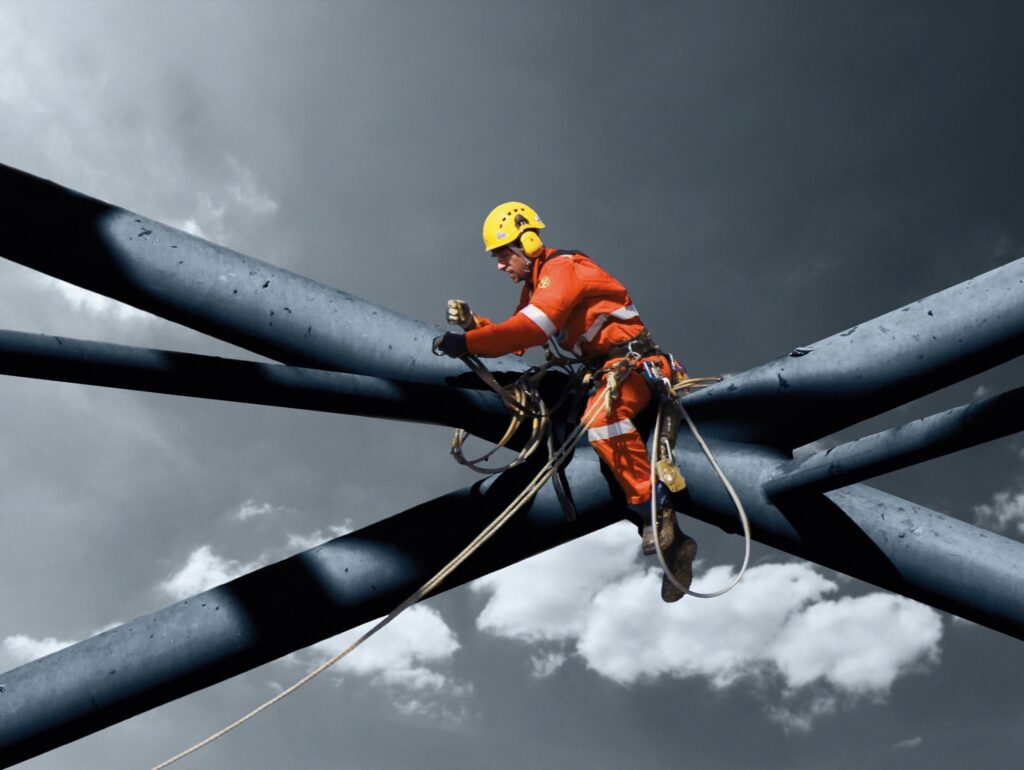
On complex industrial structures, rope access technicians reach the work location via a system of ropes, anchors and safety lines attached to the structure itself. Once the technician is in position, they carry out the entire technical task: welding, coating, inspecting, insulating or dismantling. Access and execution take place at the same time, by the same person.
For situations in which rope access alone offers insufficient working surface, Sky-Access deploys the modular SkyDeck platform. This patented suspended platform is attached to the main structure using tensioning chains and is wider than the structure itself, so the sides can be reached as well. For bridge maintenance, the SkyDeck can be deployed without closing traffic lanes, which is mandatory with traditional suspended scaffolds.
For spherical tanks and silos, Sky-Access uses a patented Mono Arm that makes the walls fully accessible. A maintenance cycle that takes five weeks with conventional scaffolding can be completed in one week with this system, with fewer people on site and a lower risk profile.
Multidisciplinary teams carry out the full scope: a single team handling coating, insulation, NDT inspection and welding completes the entire assignment without another contractor having to be scheduled. This shortens the turnaround time and considerably reduces the coordination burden for the client. More about the sectors and applications can be found on the industry and offshore page.
When is rope access not the right choice?
Rope access is not the right choice when work takes place structurally and for a long period on large, continuous surfaces where a large number of people must be present at height permanently. Think of the structural work on an apartment building, where bricklaying at height takes place over a long period. In those cases, scaffolds are more efficient because they provide a permanent, stable workplace for a large team.
In addition, rope access is not suitable when lifting weights structurally exceed 300,000 kilograms. Other methods are required for heavy lifting.
Outside these two categories, however, the scope of rope access is broader than many clients expect. Welding, NDT inspections, coating, insulation, corrosion under insulation (CUI), fireproofing measures and emergency repairs can all be carried out via rope access, even at hard-to-reach or geometrically complex locations. The assumption that rope access is unsuitable for precise or heavy technical work is incorrect: the method is the means of transport to the workplace, not the determining factor for the technical quality of the work.
Which certifications should a rope access company have?
A serious rope access company must hold an IRATA company certification, a VCA-P certification and preferably ISO 9001. The crucial distinction lies in the IRATA company certification: many companies work with IRATA-certified technicians but are not themselves certified as a company. That is a fundamental difference.
An IRATA-certified company is supervised by the international IRATA organization, is required to register all hours and incidents, and undergoes a full external audit every three years. A non-certified company does not have to report incidents and is not checked on procedures and equipment inspection. This has direct consequences for safety and for the client's liability.
Cheap rope access providers often do not have their own inspected equipment and let technicians work with their own ropes and harnesses. The periodic inspection of climbing equipment is then not guaranteed. A certified company works exclusively with its own, periodically certified and inspected equipment.
The VCA-P certification, the petrochemical variant of the Safety, Health and Environment Checklist for Contractors, is the highest VCA level and mandatory for work in the petrochemical industry. ISO 9001 safeguards the quality management system. Sky-Access holds all three, including IRATA company certificate number 5025/0, and has been IRATA-certified as a company for more than 15 years. An IRATA Level 3 supervisor is mandatory on every job.
How do you calculate whether rope access is cheaper than scaffolding?
The calculation does not start with the hourly rate, but with the total project costs. Add up the costs of the scaffolding contractor and the technical contractor, including erection and dismantling time, rental period and logistical delays. Compare that total with the integrated costs of a rope access team that combines access and execution.
The factors that determine the savings are:
- Turnaround time: a shorter execution time means earlier recovery of the installation and lower downtime costs
- Material on site: no scaffold tubes, couplers or planks that have to be delivered, stored and removed
- Logistical freedom: rope access does not block traffic routes or loading and unloading positions, so other work on the site can continue
- Coordination burden: one party instead of two reduces planning risk and communication costs
- Mobilization speed: rope access teams mobilize quickly and in many cases can start on the same day as the inspection
The hourly rate of an IRATA-certified rope access company is sometimes slightly higher than that of a non-certified provider, because stricter requirements, company certification and a mandatory Level 3 supervisor entail extra costs. The overall solution is nevertheless cheaper in most cases, because the scaffolding contractor as a separate party disappears entirely and the turnaround time is considerably shorter. In the petrochemical industry, where turnarounds last six to eight weeks and every day of downtime has directly measurable costs, that difference can be substantial.
Related Articles
- What Does Industrial Maintenance at Height Cost on Average?
- What Are the Benefits of Technical Maintenance Without Scaffolding?
- How does a blade repair on an offshore wind turbine work?
- What Are the Most Common Damage Patterns in Wind Turbine Blades?
- How to Choose a Reliable Subcontractor for Maintenance at Height

 NL
 EN