Rope access has statistically the lowest incident rate of all common methods for working at height. This makes it, when carried out by a certified company with trained specialists, the safest choice in most industrial situations. The questions below go deeper into the figures, the causes of accidents with alternative methods, and the standards that make rope access so reliable.
Which method has statistically the lowest incident rate?
Rope access demonstrably has the lowest incident rate of all methods for working at height. The Industrial Rope Access Trade Association (IRATA) requires its certified members worldwide to record all hours worked and all incidents. This data consistently shows that the number of fatal and serious incidents per hour worked is lower for rope access than for scaffolding or aerial work platforms.
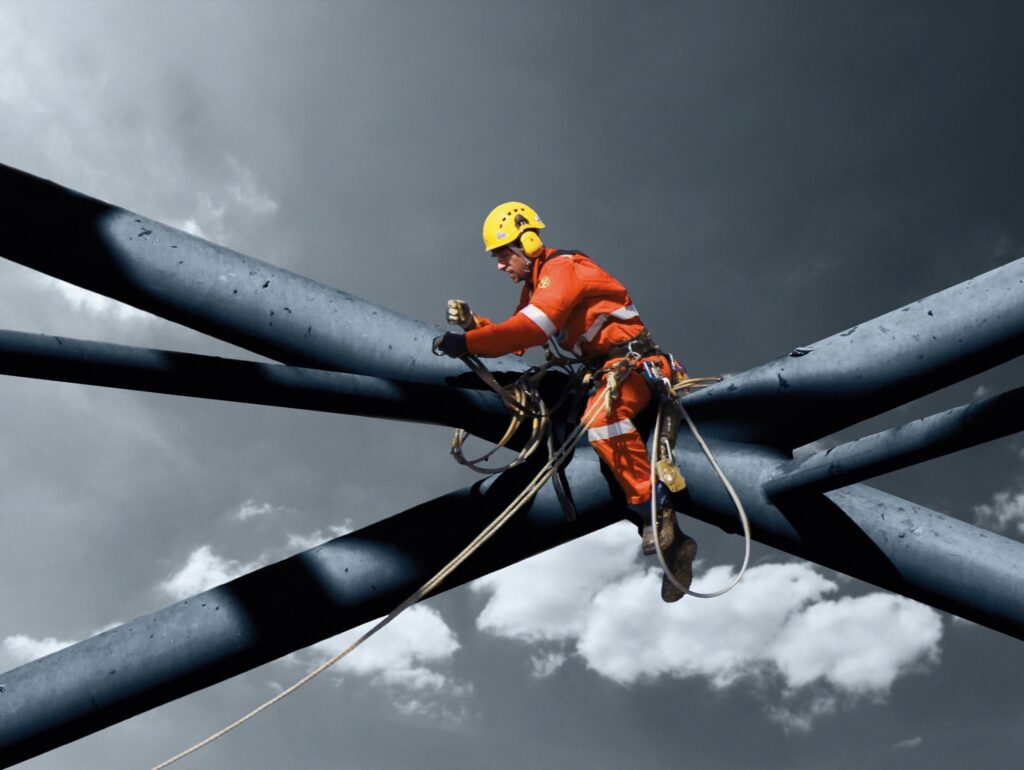
The explanation lies at the core of the method. A rope access technician is secured at all times via multiple anchor points. There is never a moment when they work at height unprotected. This is fundamentally different from scaffolding work, where fitters in practice regularly detach their personal fall protection in order to move more easily. With rope access this is physically impossible: the technician hangs in the system, and the system is the workplace.
This distinction is relevant for buyers and HSE managers during tenders. A method that structurally shows lower incident figures reduces not only the human risk but also the legal and operational exposure of the client.
Why are there more fatal accidents with scaffolding?
Scaffolds are not in themselves an unsafe workplace, but the way fitters behave on them leads in practice to a higher number of fatal fall incidents. The main cause is that fitters on a scaffold disconnect their personal fall protection in order to move more freely. A single lanyard that has to be repeatedly clipped on and off is perceived as cumbersome, which makes the temptation to skip it great.
With rope access this temptation structurally does not exist. The technician is connected to the rope system and cannot reach or leave the workplace without that system. Safety is not an extra step in the work routine, but the work routine itself. This two-point system, in which a working line and a safety line are always present, ensures that the technician remains protected even if one component fails.
An additional factor is that erecting a scaffold is itself a moment of risk. During the assembly and dismantling of scaffolding material, fitters are exposed to situations in which the definitive fall protection is not yet in place. Rope access avoids this problem: the rope system is set up from a safe point, and the technician only descends once the system has been inspected and approved by the level 3 supervisor on site.
Which safety standards apply to rope access?
The international standard for industrial rope access is the IRATA standard, drawn up by the Industrial Rope Access Trade Association. This standard specifies requirements for the training and certification of technicians, procedures for setting up rope systems, recording of hours worked and incidents, and audits of certified companies. In addition to the IRATA standard, VCA-P and ISO 9001 are also relevant company certifications for rope access providers in the Netherlands.
IRATA company certification versus certified fitters
A crucial distinction that buyers often overlook: many companies work with IRATA-certified fitters but are not themselves certified as a company. A non-certified company is not supervised by the international IRATA organization and is not obliged to report incidents. This makes the incident data of such companies unverifiable.
An IRATA-certified company, such as Sky-Access with company certificate number 5025/0, is fully audited every three years. Climbing equipment, procedures and records are held in a system that external auditors check. All fitters hold a personal IRATA certificate at level 1, 2 or 3. For every job a level 3 supervisor must be present, who is responsible for rope safety and for setting up the rope system. You can read more about how this works in practice on the page about rope access from Sky-Access.
VCA-P and ISO certifications
In addition to IRATA company certification, VCA-P is the highest attainable company certification for contractors in industry, and is specifically required for work in the petrochemical sector. ISO 9001 safeguards the quality management system. Only a few rope access companies in the Netherlands can demonstrate this combination of certifications. For clients working in regulated environments, such as offshore oil and gas or petrochemicals, these certifications are not a side issue but a hard procurement requirement.
Is an aerial work platform safer than scaffolding?
An aerial work platform and a scaffold are both means of access, not working methods. The safety comparison that really matters in an industrial context is the one between the complete execution method including access on the one hand, and rope access on the other. Both platform-based methods carry comparable risks regarding personal fall protection and depend on the correct behavior of the user at the workplace.
What aerial work platforms and scaffolds have in common is that they provide a workplace that still has to be staffed by a separate technical party. Rope access combines access and execution in one: the technician reaches the workplace via the rope system and carries out the technical work from that same system. This eliminates a link in the chain and with it the associated coordination and safety risks.
Aerial work platforms are also of limited use at locations with insufficient ground bearing capacity, limited maneuvering space, or structures that cannot be approached from above. At such locations rope access is not only safer in statistical terms, but also the only practically feasible method.
When is rope access the safest choice for a project?
Rope access is the safest choice when the work location is difficult to reach with conventional methods, when minimizing exposure to unprotected situations is a priority, or when the client works with a certified rope access partner that integrates access and technical execution. In most industrial maintenance situations rope access meets all of these criteria at the same time.
Specifically, rope access is the preferred method for inspection, maintenance, welding, coating, NDT inspections and emergency repairs at height or in confined spaces. Think of maintenance on offshore platforms, turbine blades, bridge structures, tanks and industrial installations. At all these locations rope access offers a smaller footprint, faster mobilization and a demonstrable safety record.
There are situations in which rope access is less efficient, namely long-term work on large continuous surfaces during the shell construction phase, or with structural lifting weights above 300,000 kg. But for the vast majority of technical maintenance work in industry, offshore and wind energy, the opposite applies. A serious client will therefore always choose an IRATA-certified company that, in addition to rope safety, also keeps the technical execution in its own hands.
For clients in the offshore industry it also holds that the combination of minimal footprint, fast mobilization and demonstrable certification are decisive procurement factors. Rope access structurally scores better on all these points than platform-based alternatives, especially when the contractor holds both IRATA company certification and VCA-P.
Related Articles
- What Does Industrial Maintenance at Height Cost on Average?
- How does a blade repair on an offshore wind turbine work?
- What Is the Difference Between an NDT Inspection and a Visual Inspection?
- Why does erecting scaffolding take so much time in industrial maintenance?
- How do you know if a maintenance company has the right certifications?

 NL
 EN