Technical maintenance on industrial installations is carried out using methods that combine safe access with technical execution at height or in confined spaces. The most commonly used methods are scaffolding, aerial work platforms and industrial rope access. Which method is most suitable depends on the location, the nature of the work and the desired turnaround time. The questions below give a complete picture of how this works in practice.
Which methods are used for maintenance on hard-to-reach installations?
Three main methods are used for maintenance on hard-to-reach industrial installations: traditional scaffolding, motorized aerial work platforms and industrial rope access. Each of these methods has its own area of application, cost structure and logistical impact on the site.
Scaffolding is the best-known method. A scaffolder builds a temporary platform around or beneath the installation, after which a separate technical contractor carries out the actual maintenance work. This always means two parties, two planning streams and a longer turnaround time. In addition, scaffolds often block driving routes, loading and unloading positions and access roads on an industrial site.
Aerial work platforms are suitable for relatively easily accessible locations at limited height, but they depend on drivable ground and sufficient space. In the case of complex structures, offshore environments or locations with load-bearing restrictions, they quickly drop out as an option.
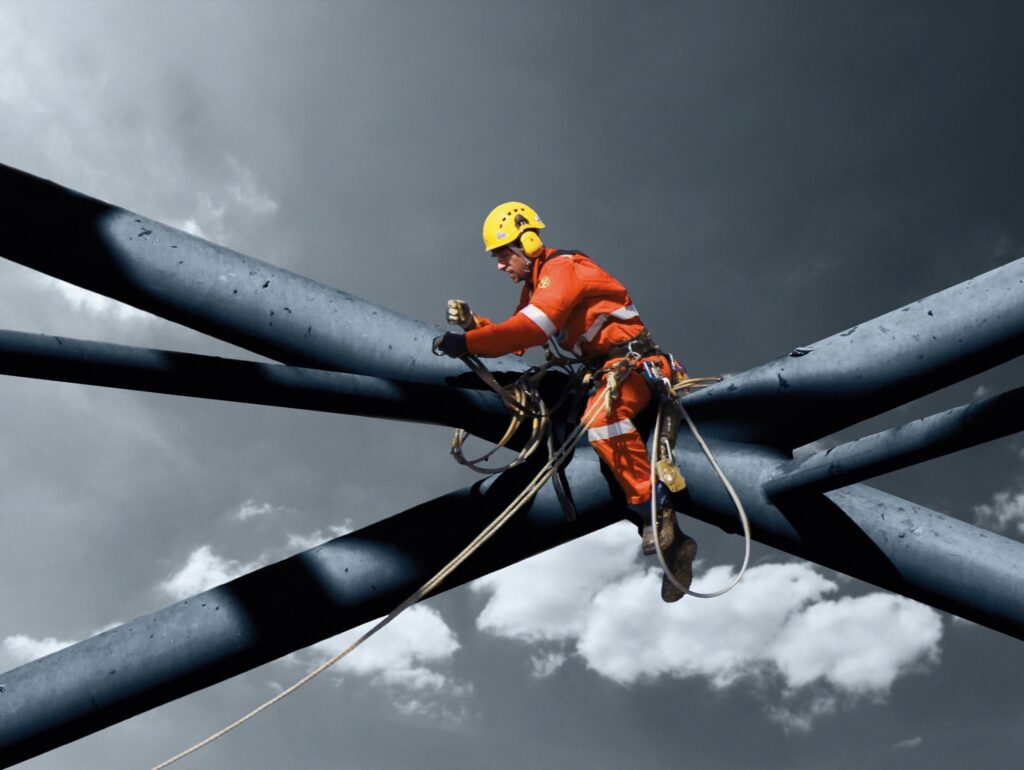
Rope access, also known as industrial rope work, combines access and technical execution in a single team. The technician reaches the work position via a rope system and carries out the work directly on site. This eliminates the need for a separate access structure and makes the method particularly effective at hard-to-reach locations such as offshore platforms, tall industrial structures, tanks and confined spaces.
What is the difference between rope access and traditional scaffolding?
The core difference is that a scaffolder only supplies a physical platform, whereas a rope access specialist handles both access and technical execution. The right comparison is therefore not rope access versus a scaffolder, but rope access versus a scaffolder plus a separate technical contractor.
With traditional scaffolding, at least two parties are always involved: the party that builds the platform and the party that carries out the technical work. This extends the turnaround time, increases the coordination workload and raises the risk of scheduling conflicts. Moreover, erecting and dismantling a scaffold in itself takes significant time before the actual maintenance can begin.
A rope access team brings its own work position with it. No separate platform is needed, no second contractor and no waiting time for the construction of an access structure. The team can mobilize faster, start the technical work sooner and get the installation back into operation earlier. Every day less downtime directly means less loss of production revenue for the client.
In terms of safety, statistics show that rope access has fewer fatal fall incidents than scaffolding work. On scaffolds, technicians regularly unclip themselves to move around more easily, which creates fall risks. Rope access technicians are attached at all times via a two-point system and may not leave the work position unless both attachment points are secured.
Which technical work can be carried out with rope access?
Via rope access, virtually all technical maintenance disciplines that are also performed from a scaffold or aerial work platform can be carried out. The method is not limited to inspection or light tasks: heavy and precise work such as welding, blasting and carrying out non-destructive testing (NDT) is also part of the standard repertoire.
The main disciplines carried out via rope access in industry are:
- Mechanical maintenance: welding, assembling and dismantling structures and installations at height or in confined spaces
- Blasting and painting: surface treatment of steel structures, offshore platforms and industrial installations
- Insulation and corrosion under insulation (CUI): applying and repairing insulation on pipes, tanks and boilers, including investigation of corrosion beneath existing insulation
- Non-destructive testing (NDT): inspections in which the structure remains intact, including in hard-to-reach spaces
- Tank inspection, maintenance and repair: including spherical gas tanks and cylindrical storage tanks via specialized access systems
- Industrial cleaning: cleaning of confined spaces, tanks and industrial installations
- Fire protection measures: applying and repairing fire-resistant coatings and materials on steel structures
A multidisciplinary rope access team can combine several of these disciplines within a single deployment. One team with coating, insulation, NDT and welding specialists carries out the entire scope, which leads to a lower coordination workload, shorter turnaround time and better quality assurance. For situations where rope access alone is insufficient for prolonged heavy work, a modular suspended platform such as the SkyDeck system can be deployed in addition.
How does a typical maintenance project on an industrial installation proceed?
A typical industrial maintenance project via rope access goes through four phases: preparation and risk analysis, mobilization, execution, and handover with documentation. The turnaround time is considerably shorter than with conventional methods, because there is no time-consuming scaffold erection beforehand.
In the preparation phase, the scope of the work, the anchor points, the required disciplines and the safety procedures are defined. An IRATA level 3 supervisor is responsible for setting up the rope system and for the rope-related safety of the job. For confined spaces, the rescue system is also set up in advance, so that your own staff or third parties can be evacuated quickly and safely in the event of an incident.
Mobilizing a rope access team is considerably faster than erecting a scaffold. The team arrives with compact equipment, has a small footprint on the site and does not obstruct logistical movements such as driving routes and loading and unloading positions. This is a concrete advantage on busy industrial sites where multiple contractors are active at the same time.
During execution, quality controls are built into the work process. For coating work, for example, the humidity is measured daily, layer thickness measurements are carried out and documented, and pull-off tests are performed on the new coating. This is relevant because clients find it difficult to inspect work at height themselves. After completion, handover follows with full documentation in accordance with the applicable industry standards.
When is rope access the better choice over an aerial work platform or scaffold?
Rope access is the better choice when the location is difficult to reach with conventional means, when turnaround time is a critical factor, or when the logistical impact of a scaffold on the site is too great. In most industrial maintenance situations, rope access delivers a shorter turnaround time, less equipment on site and a faster restart of the installation.
Specific situations in which rope access is clearly preferable:
- Locations where an aerial work platform cannot drive due to limited space, poor ground conditions or load-bearing restrictions of the floor or roof structure
- Offshore platforms and installations at sea, where a minimal footprint and fast mobilization are decisive procurement factors
- Industrial sites where scaffolds would block driving routes, loading and unloading positions or access roads
- Emergency repairs where work must start quickly without waiting for scaffold erection
- Structures with complex geometry, such as the underside of bridges, locks or offshore helidecks
- Confined spaces such as tanks, columns and pipe shafts
There are situations in which a scaffold is more efficient: for long-term work on large continuous surfaces where work is carried out at height permanently, such as the shell construction of an apartment building, scaffolds weigh more heavily. Industrial rope access is primarily strong in inspection, maintenance, cleaning, coating, lightning protection and emergency repairs at hard-to-reach locations.
For offshore and heavy industry, the advantages of rope access are the most pronounced, because there the speed of mobilization and demonstrable safety directly affect total project costs.
Which certifications must a rope access company have for industrial maintenance?
For industrial maintenance via rope access, three certifications are decisive: IRATA company certification, VCA-P and ISO 9001. Of these three, IRATA company certification is the most distinguishing quality mark, because many companies employ IRATA-certified technicians but are not themselves certified as a company.
IRATA company certification
IRATA (Industrial Rope Access Trade Association) is the international standard for industrial rope access. The crucial distinction is the difference between a company with IRATA-certified personnel and a company that is itself IRATA-certified as an organization. A non-certified company is not supervised by the international IRATA organization and is not obliged to report incidents. A certified company is fully audited every three years, comparable to a VCA-P audit.
Within the IRATA system, technicians work at three levels: level 1 (entry level, working under supervision), level 2 (independent work after additional training and hours) and level 3 (highest level, comparable to a pilot with flight hours). On every job, an IRATA level 3 supervisor is required to be present, who is responsible for rope-related safety and for setting up the rope system.
VCA-P and ISO certifications
VCA-P is the highest variant of the Safety, Health and Environment Checklist for Contractors (VCA) and is mandatory for work in the petrochemical industry. The P stands for Petrochemical. Always write VCA-P, not VCA or VCA**. ISO 9001 certification safeguards the organization's quality management system.
A serious client always chooses an IRATA-certified company. This is not only a quality guarantee but also relevant in tenders and permit procedures, where HSE managers and procurement officers assess a contractor's safety record and certification structure. Cheap rope access providers often do not have their own inspected equipment and have technicians work with their own ropes and harnesses, which calls the inspections and safety into question.
Sky-Access holds IRATA company certificate number 5025/0, VCA-P certification and ISO 9001, and has been IRATA-certified as a company for more than 15 years. More about the background and working method can be found on the page about Sky-Access.
Related Articles
- How to Minimize Downtime in Industrial Maintenance?
- What Does Industrial Maintenance at Height Cost on Average?
- What Is the Difference Between Maintenance With and Without Scaffolding?
- What Is the Difference Between Onshore and Offshore Wind Turbine Maintenance?
- How Are Wind Turbine Blades Inspected for Damage?

 NL
 EN