A certified maintenance company can be recognized by a combination of company certifications that have been verifiably checked with recognized certification bodies. The most relevant certifications for technical maintenance at height are VCA-P, IRATA and ISO 9001. An important point here is the distinction between company certification and personal certification: a company may employ staff with personal certificates while the company itself is not certified. In this article you will find answers to the most frequently asked questions about assessing maintenance companies on certification and quality.
Which certifications are mandatory for technical maintenance at height?
In the Netherlands, there is no legally prescribed certification for specific providers or training systems for technical maintenance at height. The law does require that employees have completed proper training in which the ability to rescue colleagues is central, and that there is sufficient supervision at the workplace. Which certifications a company must actually be able to present depends on the sector and the client.
In practice, clients in industry and petrochemicals set additional requirements that go beyond the legal minimum. The most common certifications requested in tenders are:
- VCA-P (Safety, Health and Environment Checklist for Contractors, Petrochemical variant): the highest VCA level, required for work in the petrochemical industry.
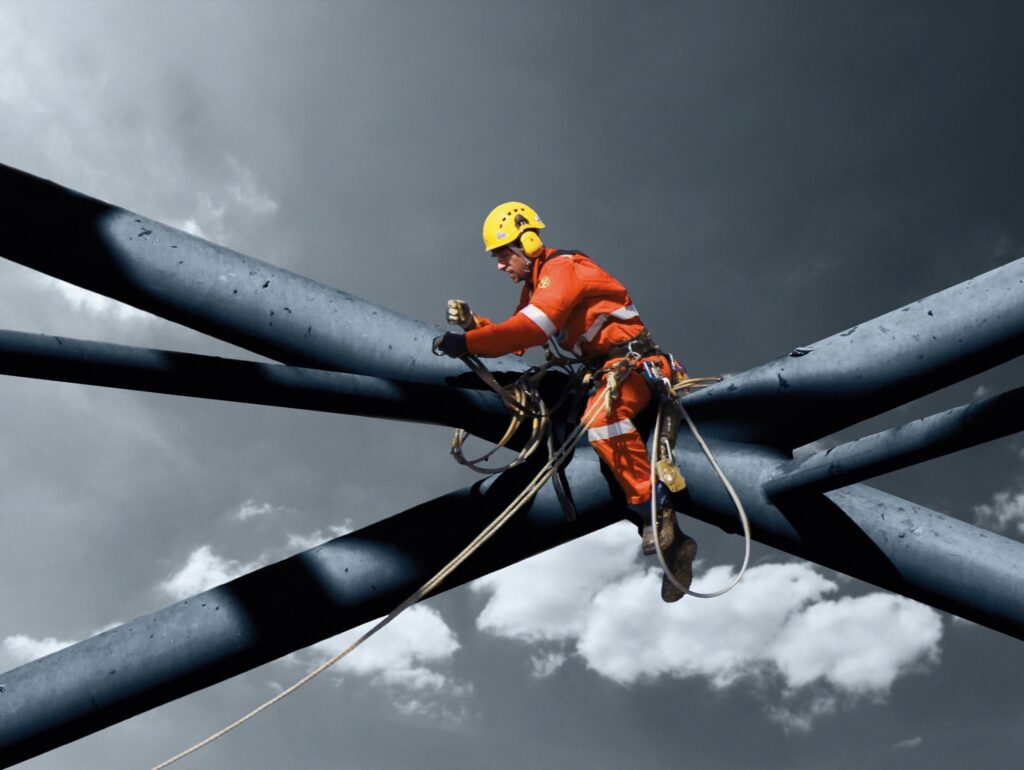
- IRATA (Industrial Rope Access Trade Association): the international standard for companies that work at height using rope techniques.
- ISO 9001: the international standard for quality management systems, demonstrating that a company controls and improves its processes.
Sectors such as offshore oil and gas, wind energy and petrochemicals generally apply stricter procurement requirements than the law prescribes. A client that takes safety and quality seriously always asks for company certifications and not only for the personal credentials of individual employees.
What does a VCA-P certification say about a maintenance company?
A VCA-P certification is the highest level within the VCA system and indicates that a company meets the strictest safety requirements for contractors active in the petrochemical industry. The P stands for Petrochemical. A certified company has demonstrably set up a safety management system, is periodically audited by a recognized certification body, and is required to record and report incidents.
VCA-P differs from the lower VCA levels in that it sets additional requirements for the safety policy of the organization as a whole, the involvement of management, and the systematic approach to risk assessments. For clients in industry, VCA-P is often a strict admission requirement: without this certificate, you do not get onto the site.
What VCA-P does not cover is the technical quality of the work performed or the specific method of accessing height. Additional certifications are needed for that, such as IRATA for rope access or ISO 9001 for quality management. A strong maintenance company combines VCA-P with these additional qualifications.
Why is IRATA certification particularly important for rope access companies?
IRATA company certification is the international standard for companies that use industrial rope access, and it matters for a crucial reason beyond simply employing certified staff: an IRATA-certified company is supervised by the international IRATA organization, is required to record all working hours and incidents, and is fully audited every three years. A company without IRATA company certification has no reporting obligations whatsoever.
Many rope access companies work with IRATA-certified technicians but are not certified as a company themselves. This is a significant difference. With a non-certified company, procedures, equipment inspection and incident registration are not laid down in a system that is externally monitored. This has direct consequences for safety and for the client's liability.
The three IRATA levels and what they mean on the job
Individual rope access technicians work with a personal IRATA certificate at three levels. Level 1 is the entry level, obtained after a week of training and an exam, where the technician works under supervision. Level 2 requires a demonstrable number of hours worked and additional training. Level 3 is the highest level, comparable to a pilot who has built up flight hours: this specialist is responsible for the rope safety of the entire job and for setting up the rope system.
Company certification versus personal certification
The key distinction for clients: do not only ask whether employees are IRATA-certified, but also whether the company itself has an IRATA company certificate number. A serious provider can present this number immediately and is verifiably listed in the international IRATA register. This is the only way to verify that a company is actually under external supervision. Sky-Access is IRATA-certified as a company with certificate number 5025/0 and has been a Full Member of the IRATA organization for more than 15 years.
How do you check whether a company is truly certified?
You should always verify certifications with the certification body itself, not solely on the basis of a document supplied by a company. Every recognized certificate has a unique number and a validity period that can be checked externally. A company that has difficulty providing current certificate numbers or references to the certification register deserves closer scrutiny.
Concrete steps for checking certifications:
- Ask for the certificate number and look up the company in the register of the certification body. IRATA maintains a public member register; VCA-certified companies can be found via the Stichting Samenwerken Voor Veiligheid (SSVV).
- Check the validity period. Certifications expire and must be renewed periodically through re-audits. An expired certificate offers no guarantees.
- Ask for the most recent audit report. A transparent company can explain the results of its latest external audit, including any points for improvement.
- Verify the personal certificates of the employees who will actually be deployed. With IRATA, individual technicians can be found in the IRATA database based on their personal certificate number.
Also pay attention to equipment inspection: reliable rope access companies work exclusively with their own, periodically inspected equipment. Cheaper providers sometimes let technicians work with their own ropes and harnesses, which makes the traceability of inspections impossible.
What questions should you ask when assessing a maintenance company?
When assessing a certified maintenance company, it is not only about having the right paperwork, but about whether the company also lives up to its certifications in day-to-day practice. The most telling questions focus on supervision on the job site, responsibility for equipment, and the breadth of technical execution.
Ask these questions of every maintenance company you consider:
- Is the company itself IRATA-certified, or only its individual employees? This is the most critical distinction for rope access companies.
- Is an IRATA Level 3 supervisor mandatory on every job? This is a requirement within the IRATA standard and a hard safety indicator.
- Does the company hold VCA-P certification? This is the highest company certification for contractors in industry and an admission requirement for petrochemical sites.
- Does the company work with its own, periodically inspected equipment? Ask about the equipment management system and the inspection frequency.
- Does the company carry out the technical work itself, or is it purely an access provider? The most cost-efficient and safest solution is a party that provides access and technical execution in one.
- How is quality assurance on the job site guaranteed? Think of coating thickness measurements, pull-off tests on coatings, and documentation of environmental conditions.
This last point deserves extra attention: clients can rarely check work at height themselves. A reliable maintenance company safeguards quality proactively, with measurable results and documented reports. For technical maintenance in demanding environments such as offshore or petrochemicals, this is not a side issue but a basic requirement.
Finally: always assess a maintenance company on the total cost of the assignment, not only on the hourly rate. A company that combines access and technical execution works with less equipment, fewer people on site and a shorter lead time. That translates into lower total costs and a faster restart of your installation. Sky-Access combines VCA-P, IRATA company certification and ISO 9001 with multidisciplinary technical execution via rope access, which in most cases results in a shorter lead time and lower total costs than a combination of a scaffolder and a separate technical contractor.
Related Articles
- Which method is safest for working at height?
- How Is Technical Maintenance Carried Out on Industrial Installations?
- What Is Technical Maintenance at Height in Industry?
- What Is the Difference Between Onshore and Offshore Wind Turbine Maintenance?
- Why does erecting scaffolding take so much time in industrial maintenance?

 NL
 EN