You minimize downtime during industrial maintenance first and foremost by aligning the access method, the team composition and the planning so that inspection and repair coincide as much as possible and logistical delays are eliminated. Choosing a method that mobilizes faster, takes up less site space and does not require a separate contractor to carry out the technical work is the most decisive factor. The questions below each explore these factors in concrete terms.
What are the biggest causes of unnecessary downtime in industrial maintenance?
The biggest causes of unnecessary downtime in industrial maintenance are separate responsibilities for access and execution, slow mobilization of equipment, logistical blockages on site, and postponing inspections until repairs can no longer wait. Each of these factors extends the period during which a facility is not productive, regardless of the technical complexity of the work itself.
In the petrochemical industry, plants are typically shut down every two to four years for what is known as a turnaround: a period of six to eight weeks of planned major maintenance. During such a shutdown, a large share of the available time is traditionally spent building and dismantling scaffolding, even before the technical work begins. When the scaffolder and the technical contractor are two separate parties, a coordination challenge also arises: waiting times, alignment and handovers take up time that comes directly at the expense of the operational restart.
A second structural cause is the logistical footprint of conventional access equipment. Scaffolding blocks traffic routes, loading and unloading positions and access roads on an industrial site. This not only hinders the maintenance itself, but also disrupts the broader operations around the idle facility. The longer that disruption lasts, the higher the indirect costs.
Finally, postponed inspection regularly leads to larger and more expensive repairs. When a facility is only examined at the moment problems become visible, the damage has often progressed further than it would have if a deviation had been identified earlier.
How does a multidisciplinary team shorten the lead time of a maintenance project?
A multidisciplinary team shortens the lead time of a maintenance project because all the required specialists, such as welders, NDT inspectors, and coating and insulation technicians, work as one integrated unit. No handover between parties is needed, there is no waiting for the next contractor, and there is no duplicate mobilization of equipment and personnel.
The logistical gain lies in eliminating interfaces. When coating, insulation, welding and non-destructive testing (NDT) are carried out by separate companies, each discipline has to wait until the previous one has finished its work and released the site. An integrated team can deploy disciplines partly in parallel and switches internally, without contractual or planning-related intermediate steps.
In addition, one team means a single point of contact for the client. Project managers and maintenance engineers do not have to coordinate between multiple subcontractors, each with their own schedule, material lists and safety documentation. That reduction in coordination effort translates directly into fewer planning errors and faster decision-making on the work floor.
Which access method causes the least delay in maintenance at height?
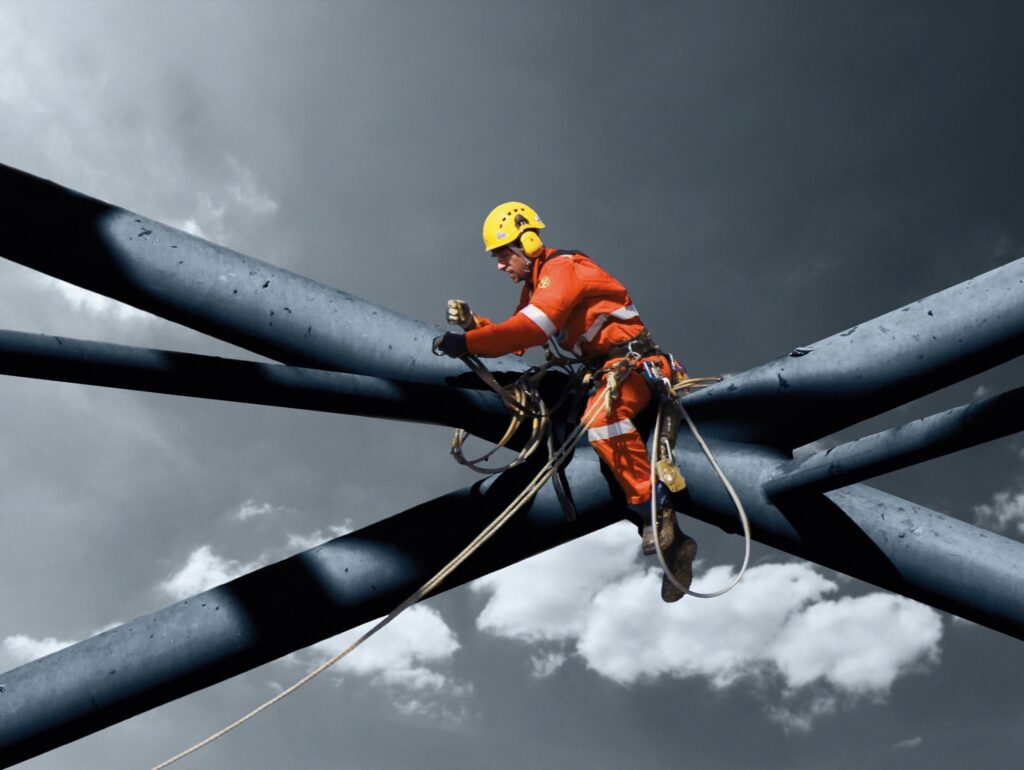
Rope access causes the least delay in maintenance at height, because the technician brings their own means of access and can start the technical work right away. There is no scaffold erection time, no waiting for an aerial work platform, and no separate party needed to create the workplace before the actual work can begin.
The relevant comparison here is not rope access versus a scaffolder, but rope access versus a scaffolder plus a technical contractor combined. With conventional methods, those are two separate parties with two separate mobilization moments. A rope access specialist is the professional who carries their access, as it were, in their own equipment: access and execution are in one hand.
For situations where work has to be carried out for a long time on large continuous surfaces, the modular SkyDeck suspended platform offers a complement: a lightweight, quick-to-assemble platform that is hung beneath structures such as bridges, offshore helidecks and locks, without lanes having to be closed. It combines the speed of rope access with the work-floor comfort of a suspended scaffold, but without the logistical drawbacks of traditional suspended scaffolding.
When is a combined inspection and repair on the same day possible?
A combined inspection and repair on the same day is possible when the executing team has both inspection and repair capacity in-house and can achieve access immediately, without first building a work platform. In many cases, rope access makes this feasible: the technician reaches the location, carries out the inspection and, if a deviation is found, can proceed directly to repair.
This is a fundamental difference from a way of working in which inspection and repair are carried out by two separate parties. In that case, after the inspection a report must first be drawn up, a repair contractor must be mobilized and a new access solution must be set up. That takes days to weeks, depending on the availability of parties and equipment.
In the wind energy sector, this combined advantage is particularly relevant. For turbines, both onshore and offshore, mobilization is costly and every day of downtime directly affects energy yield. When an inspection finds damage to a blade, such as leading edge corrosion or damage from bird strikes, a rope access team can proceed to repair with tape or coating during the same deployment. Two separate deployments are thus reduced to one.
How does the choice of access method affect logistics on an industrial site?
The choice of access method has a direct impact on the logistics of an industrial site, because scaffolding and large equipment block traffic routes, loading and unloading positions and access roads. Rope access has virtually no site footprint: no stored tubing, no lifting equipment and no closing off of lanes is needed.
On busy factory sites, where multiple disciplines are active at the same time and the transport of raw materials and products continues during a partial shutdown, that footprint is no minor matter. A scaffold that blocks a traffic route forces other departments to take detours or wait. This has a domino effect on the broader operations, separate from the maintenance work itself.
Rope access mobilizes quickly and works compactly. The team brings the necessary equipment in limited quantities, installs anchor points on the existing structure and works without permanent obstacles at ground level. For the offshore industry and petrochemicals, where operational continuity around the workplace is a top priority, that is a structural advantage over conventional access methods.
Which certifications must a maintenance company have to work safely and quickly?
A maintenance company that works safely and quickly at height and in confined spaces must have at minimum an IRATA company certification, a VCA-P certification and an ISO 9001 quality management system. This combination guarantees that both safety assurance and quality control are demonstrably documented and externally audited.
IRATA company certification: the crucial distinction
Many companies work with IRATA-certified technicians but are not themselves certified as a company. That distinction is decisive. A non-certified company is not supervised by the international IRATA organization and is not obliged to record and report incidents. An IRATA-certified company is fully audited every three years, must keep records of all hours worked and incidents, and works exclusively with technicians who hold a personal IRATA certificate at level 1, 2 or 3. On every job a level 3 supervisor must be present, who is responsible for rope safety and for setting up the rope system.
VCA-P and ISO 9001: requirements for industry
VCA-P is the highest attainable company certification for contractors in the petrochemical industry. The P stands for Petrochemical and imposes considerably stricter requirements than a standard VCA certification. Without VCA-P, access to most petrochemical facilities in the Netherlands is not possible. ISO 9001 safeguards the quality management system: how work processes are organized, documented and monitored. For clients who cannot check work at height themselves, this combination of certifications provides the demonstrable assurance needed in tenders and permit procedures.
A serious client always selects an IRATA-certified company, not just a company with IRATA-certified employees. The difference determines whether there is independent oversight of the provider's safety culture and procedures. Sky-Access has been IRATA-certified as a company for more than 15 years and, in addition to VCA-P and ISO 9001, also holds ISO 45001 for occupational health and safety management, a combination that few rope access companies in the Netherlands can present.
Related Articles
- When is technical maintenance without scaffolding the better choice?
- What Does Industrial Maintenance at Height Cost on Average?
- How Is Maintenance Carried Out on Hard-to-Reach Industrial Installations?
- What Is the Difference Between Maintenance With and Without Scaffolding?
- What Is Technical Maintenance at Height in Industry?

 NL
 EN