The cost of industrial maintenance at height varies widely from situation to situation, but one factor is decisive: the access method. Whether you choose traditional scaffolding or rope access largely determines the total project cost, the lead time and the amount of disruption on your site. The comparison business clients should make is not "scaffolding versus rope access", but scaffolder plus technical contractor versus an integrated rope access specialist. This article answers the most frequently asked questions about costs, methods and certifications for working at height in industrial environments.
What factors determine the cost of working at height?
The cost of working at height is determined by four main factors: the accessibility of the work location, the chosen access method, the technical complexity of the work itself, and the project's duration. Each of these factors directly affects the number of people required, the amount of equipment on site and the time a facility is out of service.
Accessibility is often the most underestimated cost factor. A structure that is difficult to reach with an aerial work platform or traditional scaffolding requires extra equipment, more erection time and sometimes the closure of driving routes or loading and unloading areas on the site. This logistical disruption has a direct cost: blocked access roads delay other work and extend the total downtime of the facility.
The technical nature of the work also plays a major role. Welding work, non-destructive testing (NDT), corrosion under insulation (CUI) or blasting and painting work each place different demands on the workplace, the safety measures and the required certification of the team carrying out the work. The more disciplines are needed at the same time, the greater the advantage of a multidisciplinary team that can carry out the full scope in a single deployment.
Finally, downtime is a direct cost item for the client. Every day a facility is not producing costs revenue. The speed at which a team can mobilize and start the technical work is therefore just as important a cost factor as the hourly rate of the contractor.
What are the cost components of traditional scaffolding?
The total cost of traditional scaffolding consists of two separate parts: the scaffolder who supplies and erects the platform, and the technical contractor who carries out the actual maintenance work. These two parties are usually contracted separately, which results in two cost items, two schedules and two points of contact.
The cost components of scaffolding include material costs for tubes, couplers and planks, transport costs to and from the site, labor for erection and dismantling, rental costs for the entire period of use, and any permits for occupying public space or closing driving routes. On long-running projects, rental costs add up considerably, especially when the scaffolding system remains in place longer than originally planned.
On top of that come the costs of the technical contractor: the specialists who actually carry out the maintenance, inspection or coating. This party has its own mobilization costs, its own schedule and its own safety requirements. Coordination between the scaffolder and the technical contractor takes time and increases the risk of waiting time when one party's schedule overruns.
In turnaround situations in the petrochemical industry, where a plant is completely shut down for six to eight weeks for major maintenance, large quantities of scaffolding are traditionally built. In that context, the combined costs of scaffolding and technical contracting can reach amounts that strongly affect the overall project economics.
How do the costs of rope access compare to scaffolding?
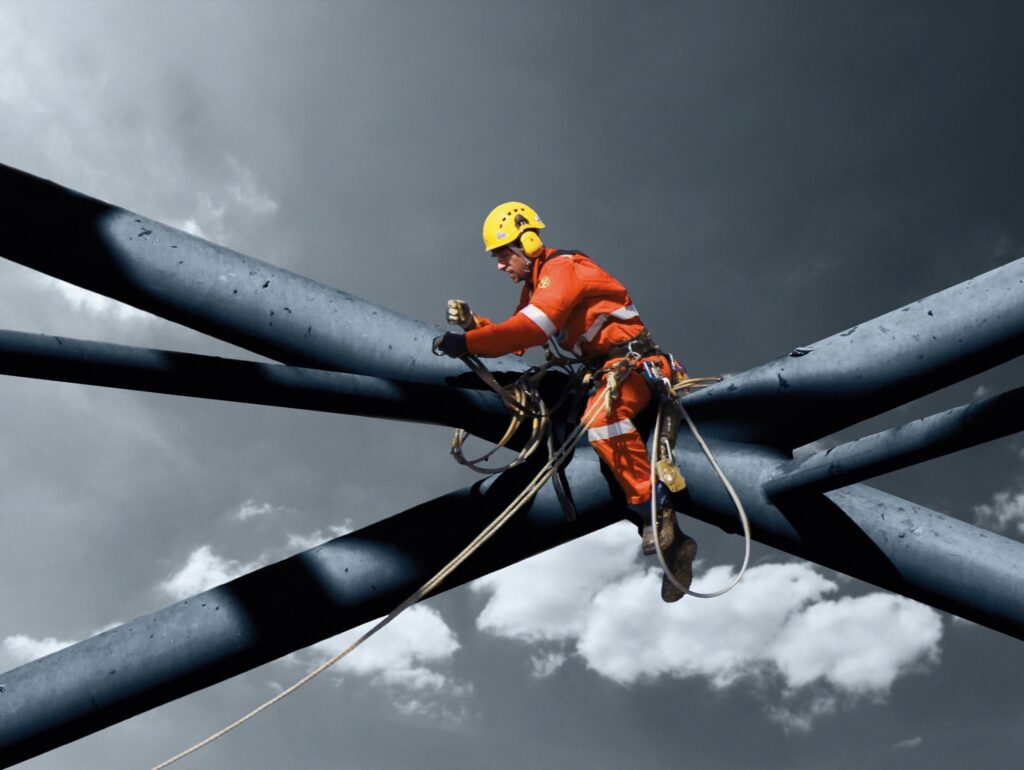
In most cases, rope access is considerably cheaper than the combined costs of a scaffolder and a technical contractor. The cost saving does not come from a lower hourly rate, which may even be slightly higher, but from shorter lead times, less equipment on site and the integration of access and execution in a single team.
The right comparison is crucial: a rope access specialist is not a scaffolder. A scaffolder supplies only the platform; the technical contractor then carries out the work. A rope access specialist combines both roles. Access and execution are in one hand, which delivers one party, one point of contact and one integrated schedule.
The concrete advantages that tip the cost comparison in favor of rope access are:
- Shorter lead time: no scaffold erection time is needed, so the technical work can start sooner and the facility returns to operation earlier.
- Less equipment on site: no large quantities of tubes, couplers or planks, less transport and less space used on the site.
- No logistical disruption: scaffolding blocks driving routes, loading and unloading areas and access roads. Rope access has virtually no impact on the surroundings and does not obstruct other operational processes.
- One contracting party: the coordination costs between scaffolder and technical contractor disappear entirely.
On turnaround projects in the petrochemical industry, the difference can run into millions of euros per client. The exact saving varies per project and depends on the size, the complexity and the location. Fixed percentages are therefore misleading and are not used by serious providers.
When is rope access the cheapest option for maintenance at height?
Rope access delivers the greatest cost advantages on projects where the work location is difficult to reach, the lead time is critical, or multiple technical disciplines have to work at height at the same time. The more of these factors apply, the greater the economic advantage over scaffolding plus technical contracting.
Concrete situations in which rope access is structurally cheaper:
- Turnarounds in the petrochemical industry: the combination of time pressure, multiple disciplines and large quantities of required scaffolding makes rope access a cost-efficient alternative.
- Offshore structures: on offshore platforms and installations, speed of mobilization and a minimal footprint are decisive. Rope access meets both requirements.
- Infrastructure: maintenance on the underside of bridges, locks and viaducts requires lane closures with traditional suspended scaffolding. With the modular SkyDeck platform, this work can be carried out without closing a lane, which delivers direct cost savings for the client and for the surrounding area.
- Wind energy: inspection and repair of offshore wind turbine blades using a patented blade platform saves more than €100,000 per deployment compared to a crane vessel.
- Emergency repairs: rope access teams can mobilize quickly and start immediately, without waiting for scaffold erection time.
There are situations in which scaffolding is more efficient: for long-term work on large continuous surfaces where people work at height permanently, such as the shell construction of a building, fixed scaffolding is better suited. Rope access is not a universal solution, but for most industrial maintenance tasks at hard-to-reach locations it is the economically strongest choice.
Which certifications affect the price of a rope access assignment?
A rope access company's certifications have a direct effect on the price of an assignment. Companies that meet stricter certification requirements have higher operating costs, but they also demonstrably deliver more safety, quality and certainty. For clients in industry, offshore and wind energy, this distinction is of great importance in tenders and permitting processes.
The most relevant certifications and their effect on price are:
- IRATA company certification: this is the crucial distinction. Many rope access companies work with IRATA-certified technicians but are not themselves certified as a company. An IRATA-certified company is supervised by the international IRATA organization, is obliged to record all hours and incidents, and is fully audited every three years. This entails extra costs, but gives the client a demonstrable safety guarantee that is lacking with non-certified providers.
- VCA-P certification: the highest VCA variant, specifically required for work in the petrochemical industry. Companies with VCA-P meet stricter requirements in terms of safety, health and environment than companies with a lower VCA variant.
- ISO 9001: a quality management system that ensures work processes and quality control are systematically documented and safeguarded.
- Mandatory presence of an IRATA level 3 supervisor: on every job by a certified company, a level 3 supervisor is present. This person is responsible for rope safety and for setting up the rope system. This increases personnel costs per deployment, but is a non-negotiable safety requirement.
A serious client always chooses an IRATA-certified company. Cheaper providers often do not have their own inspected equipment and let technicians work with their own ropes and harnesses, which calls into question the safety and the inspection of the equipment. The total solution from a certified provider is almost always cheaper than the seemingly cheaper provider whose quality and safety risks introduce hidden costs.
How do you request a reliable cost estimate for maintenance at height?
A reliable cost estimate for industrial maintenance at height starts with supplying the right project information. The more specific the brief, the more accurate the estimate, and the better you can compare providers and truly compare apples with apples.
The information a serious provider needs for a well-founded estimate:
- Location and accessibility: what is the work location, at what height is the work, and are there restrictions on placing equipment on the site?
- Nature and scope of the work: which disciplines are required: welding, NDT, coating, insulation, CUI inspection? What is the surface area or the number of components?
- Lead time requirements: is there a hard deadline, a turnaround window or a maximum downtime?
- Certification requirements: which certifications are required for access to the site or as a contractual requirement: IRATA, VCA-P, ISO 9001?
- Logistical constraints: are there restrictions on driving routes, loading and unloading areas or the use of public space?
When comparing quotes, it is essential to compare the total project costs, not just the hourly rate. A provider with a slightly higher hourly rate but a shorter lead time, less equipment and one integrated scope can turn out considerably cheaper than a provider that offers scaffolding and technical contracting as two separate items.
Ask every provider explicitly about the company's certifications, not just those of the individual technicians. Check whether the company is IRATA-certified as an organization and holds VCA-P. These are the minimum quality assurances for work in heavy industry and offshore environments. More information about the industrial and offshore applications of rope access gives insight into the scope of work for which an integrated provider offers added value.
A specialized rope access provider with multidisciplinary teams can in most cases supply a full-scope estimate: from access to handover, including all required disciplines. That makes the comparison with a traditional approach transparent and gives the client a clear picture of the true total cost of the project.
Related Articles
- Which method is safest for working at height?
- What Are the Benefits of Technical Maintenance Without Scaffolding?
- What Is Technical Maintenance at Height in Industry?
- How Is Technical Maintenance Carried Out on Industrial Installations?
- What Is the Difference Between Onshore and Offshore Wind Turbine Maintenance?

 NL
 EN