Maintenance on an industrial tank takes between one and five weeks on average, depending on the size of the tank, the type of maintenance, the chosen access method and the condition of the installation. The biggest variable is not the technical work itself, but the time lost on building the access infrastructure. The questions below work this out step by step.
Which factors determine how long tank maintenance takes?
The lead time of maintenance on an industrial tank is determined by a combination of factors: the size and geometry of the tank, the type of work, the chosen access method, the condition of the installation and the availability of certified personnel. The access method often has the greatest influence on the total project duration.
Specifically, the following factors play a role:
- Tank type and geometry: A cylindrical storage tank requires different access solutions than a spherical gas tank. With spherical tanks, reaching the entire shell has traditionally been a time-consuming logistical challenge.
- Nature of the maintenance: A visual NDT inspection takes less time than a combined scope of blasting, painting and welding. Corrosion under insulation also requires insulation material to be removed first and then reinstalled, which takes extra time.
- Condition of the installation: Unexpected findings during inspection, such as extensive corrosion or structural defects, extend the execution time. The longer maintenance has been postponed, the greater the likelihood of additional repair work.
- Access method: Scaffolding, aerial work platforms and rope access techniques have very different lead times for setup and dismantling. In most projects, this is the dominant time factor.
- Multidisciplinary scope: When several disciplines work in succession, the total lead time increases. Working with a single team that masters all disciplines significantly shortens the total execution time.
How long does standard scaffolding take for an industrial tank?
Erecting a traditional scaffold around or inside an industrial tank usually takes one to three weeks, depending on the size and complexity of the tank. Dismantling afterwards takes a comparable amount of time. For spherical tanks, scaffolding alone can take five weeks before the technical work can even begin.
This loss of time is structural and inherent in traditional scaffolding. A scaffolder supplies only the platform. The technical work, whether welding, painting, inspecting or applying insulation, is then carried out by a separate technical contractor. Both parties must be scheduled, coordinated and facilitated on site.
In addition, scaffolding on an industrial site obstructs logistical movements. Driving routes, loading and unloading positions and access roads are blocked for as long as the scaffolding system stands. For a plant running multiple workstreams in parallel during a turnaround, this is a serious operational burden.
What is the difference in lead time between scaffolding and rope access techniques?
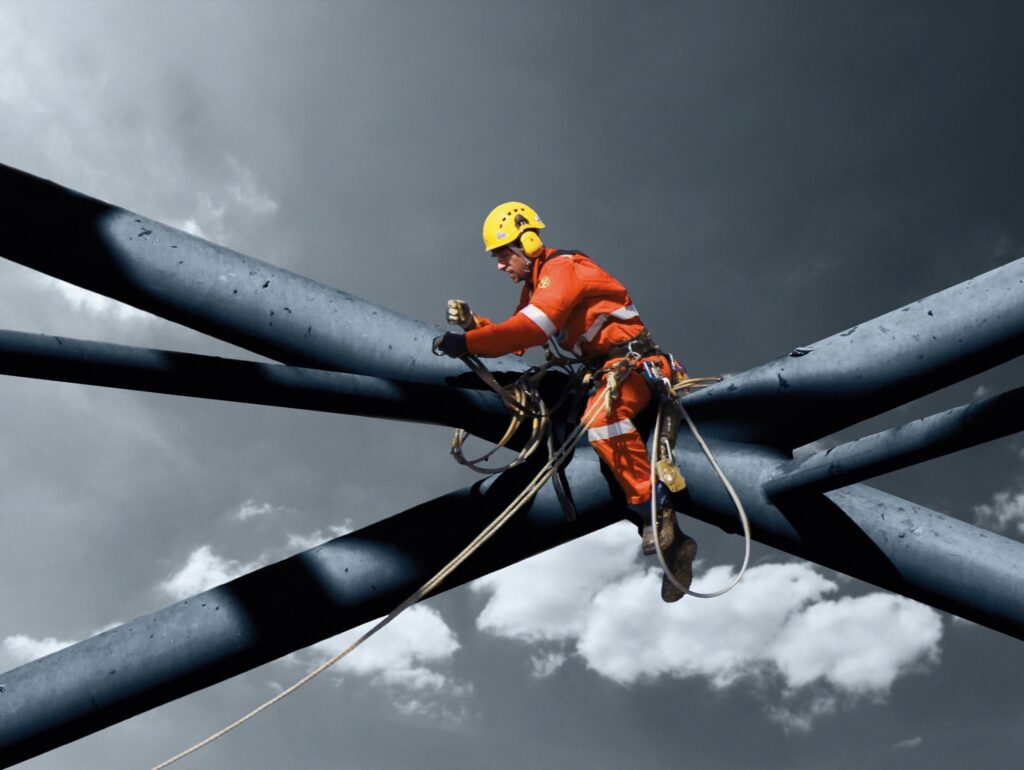
Rope access techniques almost entirely eliminate the setup time of the access infrastructure. Where scaffolding for an industrial tank takes days to weeks, rope access specialists can usually start the technical work on the day of arrival. In practice, the difference in lead time amounts to several days up to several weeks, depending on the size of the tank.
The fundamental distinction is that with rope access, access and execution are in the same hands. A rope access specialist is the skilled tradesperson who brings their own means of access. No separate scaffolder is needed, there is no waiting time for setup and no dismantling time at the end of the project. For a spherical gas tank, where conventional scaffolding can take five weeks to achieve full accessibility, a specialized rope access system provides that same accessibility within half a day. More about the working method and areas of application of this technique can be found on the page about rope access by Sky-Access.
An additional advantage is that rope access teams can be assembled on a multidisciplinary basis. A single team of welders, NDT inspectors and coating specialists carries out the entire scope without changing parties, without loss of coordination and without downtime between disciplines.
When is tank maintenance via rope access techniques the faster choice?
Rope access techniques are the faster choice when the access infrastructure would take up a significant share of the total project time, when the scope combines multiple disciplines, or when the tank is difficult to reach for conventional scaffolding. This applies in particular to spherical tanks, tanks at height, tanks in confined spaces and tanks at locations with limited logistical space.
Rope access is also the better choice when speed of mobilization is decisive. For urgent inspections or unplanned repairs, a certified team can be deployed within a short time, without equipment first having to be delivered and erected. For wind farm managers and offshore operators, where every day of downtime means direct loss of production, this is a decisive factor.
There are situations where rope access is less obvious, namely for long-term work on large continuous surfaces where work is permanently carried out at height. For most tank maintenance tasks, however, such as inspection, NDT, blasting and painting, welding and the application or replacement of insulation, rope access is excellently suited and delivers a shorter lead time than scaffolding.
Companies such as Sky-Access combine rope access with specialized systems for hard-to-reach tanks, making full accessibility of a spherical tank achievable within half a day instead of the usual five weeks with conventional scaffolding.
How does tank downtime affect total project costs?
Every day an industrial tank is out of service leads to direct loss of production. In the petrochemical industry and offshore sector, the cost of downtime per day quickly adds up to considerable amounts. The total project costs therefore consist not only of the execution costs, but to a large extent of the costs of the downtime period itself.
This means that a cheaper access method with a longer setup time can in practice turn out more expensive than a method with a higher day rate but a shorter total lead time. The right comparison is not the contractor's hourly rate, but the total costs including the downtime days that the chosen method entails.
Plants typically carry out a turnaround once every two to four years, a period of six to eight weeks during which the installation is shut down completely for major maintenance. Every day saved on the lead time of tank maintenance is a day earlier that the installation is producing again. In turnaround situations, this difference can add up to substantial savings on the total shutdown costs.
An integrated approach in which access and technical execution are in the same hands delivers not only a shorter lead time, but also less coordination effort, fewer parties on site and less equipment taking up space on the site. These are all factors that reduce total project costs, regardless of the rate per day or per hour. For clients who want to know more about how this approach works in practice, the background of Sky-Access offers a good starting point.
Related Articles
- Which method is safest for working at height?
- What Is the Difference Between Maintenance With and Without Scaffolding?
- What Is Technical Maintenance at Height in Industry?
- What Is the Difference Between Onshore and Offshore Wind Turbine Maintenance?
- Why does erecting scaffolding take so much time in industrial maintenance?

 NL
 EN